Understanding Radar Systems

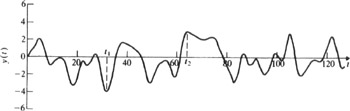
The trace y(t) available to the decision maker might appear as shown in Fig. 4.3, and at each instant (corresponding to each range), it is necessary to decide whether the value of y(t) indicates the presence of a target. For example, should the spikes at t 1 and t 2 in Fig. 4.3 be attributed to anything other than noise? This involves a judgement as to whether this value was more likely to have arisen from noise alone or from signal plus noise. The basis for this decision must be a knowledge of the frequency with which different values of y(t) will occur in the two circumstances.
A very useful way to describe how frequently y(t) takes different values is through its probability density function (PDF) p y(y). This function is defined by the property that, for small ? y, values of y(t) in the range y ? y(t) ? y + ? y will occur with frequency given approximately by p y(y) ? y
Hence, as ? y tends to 0,
(Read the left-hand-side of this equation as the probability that the measured value y(t) lies between a and b . The right-hand side is the area under the graph of p y( y) between a and b.) Since