Understanding Radar Systems

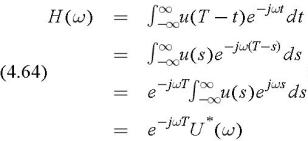
The correlation receiver has an impulse response h( t) = u( T ? t), where the constant T simply ensures causality. In the frequency domain, this gives rise to a transfer function
where we have assumed that u( t) is real [ ]. Since e ?j? T is simply a delay term, we see that the essential part of the transfer function is the complex conjugate of the Fourier transform of the transmitted pulse. This receiver transfer function is known as the matched filter.
The response of the receiver to the signal term is given by
which in the frequency domain becomes
This normally implies a loss of information about the shape of u( t), since all the phase relations between the various frequencies have been lost. The signal term in the output from the matched filter has a Fourier transform that is the energy spectrum of the transmitted pulse, multiplied by a linear phase term corresponding to range and filter delay.
[ ]For simplicity, Secs 4.7 and 4.8 have assumed a real transmitted pulse u( t). When u( t) is phase-modulated, it is normally more convenient to treat it as a complex signal. In this case, the impulse response function giving maximum SNR is
The form of the frequency domain filter (Eq. (4.64)) is unchanged.