Understanding Radar Systems

Doppler information aids target detection
Why do we choose low false-alarm rates?
How do we follow a target once it has been detected?
Separating signals from clutter, and tracking targets have become sophisticated arts.
The reliability and low cost of modern digital electronics have revolutionized radar engineering. Over the years, the A/D converter has moved progressively up the receiver chain towards the antenna, increasingly replacing analogue electronics by digital hardware and computer software. This engineering activity has two objectives: to remove unwanted clutter as far as possible, and to detect targets against the residual clutter and noise.
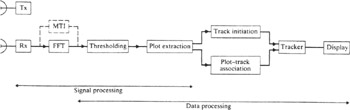
Radar engineers make a distinction between signal processing, the fast hardware processing developed mostly by electronic engineers, and data processing, which is concerned mainly with target-detection software and is very much the preserve of mathematicians. The dividing line between the two is neither clear-cut nor stationary, as it gradually moves up the receiver chain with the increasing ability of modern computers to replace hard-wired circuits. The current position for a typical radar system is shown inFig. 5.1.
The objective of this chapter is to take a guided tour through the signal processing and data processing shown in the block diagram of Fig. 5.1., but we cannot begin until we know more about the properties of the clutter we are trying to filter out. The simplistic case might be the problem of detecting an aircraft flying against a...