Understanding Radar Systems

How to cope with radio waves not travelling in straight lines in the atmosphere.
Radars frequently operate through the atmosphere of the earth, often at low elevation angles where most targets occur, but where there are most problems for the radar. Aircraft flying at constant altitude towards a surveillance radar appear over the curvature of the earth and are difficult to detect and track. Similar problems occur with ship surveillance when using maritime radar. When close to the horizontal, radar beams have their greatest path length through the atmosphere, which is itself at its most dense and turbulent. Low-elevation radar beams can also encounter obstacles, such as hills, and become diffracted into the shadow regions behind.
In this chapter we are going to investigate the radio horizon and discover whether the atmosphere, the ionosphere and the terrain significantly affect the propagation of radio waves. Again, elementary optics is useful to describe what is happening.
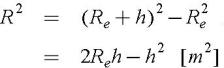
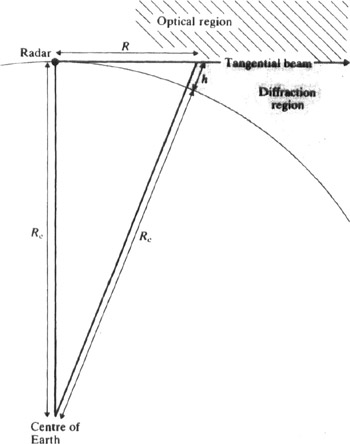
Assuming for the time being that radio waves travel in straight lines through the atmosphere, the radio horizon is defined by a line tangent to the surface of the earth, as in Fig. 8.1. If R is the range of a point on the radio horizon (or of a target appearing at zero elevation), h is the height of the point and R e the radius of the earth, then
It is...