Videoconferencing and Videotelephony: Technology and Standards, Second Edition
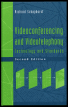
A concise and complete introduction to the design and deployment of standards-based videoconferencing and videotelephony applications.
 TABLE OF CONTENTS
 The efficient coding of video signals has been the subject of research and development for many years, and a large number of different compression algorithms have been studied. The most well-known coding techniques of the past, present, and future are listed in Table 3.2. The first two PCM and predictive (differential PCM (DPCM)) are very basic coding techniques. PCM provides no compression and is used as the reference to measure the performance of coding techniques. DPCM is still used today for the lossless coding of still pictures (for example, JPEG). Transform coding is the most dominant technique used to transmit video today. The discrete cosine transform (DCT) is used in the H.261, MPEG, HDTV, and H.263 standards. The next three techniques vector quantization, wavelets, and fractals can be considered waveform coding techniques that are competitive with the DCT. Finally, object-based coding is more advanced than the others since it isolates and encodes objects in the scene. Table 3.2 summarizes three key characteristics of these techniques, and each of these coding techniques is discussed in turn.
| Coding Techniques | Geometric Techniques the Picture Being Encoded Based | Symmetry* | |
|---|---|---|---|
| PCM | Pixel | No | S |
| Predictive (differential PCM) | Pixel | No | S |
| Transform | Square block of pixels | No | M |
| Vector quantization | Square block of pixels | No | MM |
| Wavelet | Multiresolution filtered elements | No | MM |
| Fractal | Block having any size or shape | Yes | MM |
| Object-based coding | Moving objects | Yes | MM |
| *Complexity of the encoder relative to the decoder: S, essentially the same; M,... |