Videoconferencing and Videotelephony: Technology and Standards, Second Edition
A concise and complete introduction to the design and deployment of standards-based videoconferencing and videotelephony applications.
 TABLE OF CONTENTS
 A single frame of a television image is comprised of 525 horizontal scan lines. If these frames were displayed at a rate of 30 frames/s, they would exhibit visual flicker. The frames could be displayed at twice that rate, 60 frames/s, but then the rate at which the information was being transmitted would double, thereby requiring twice as much bandwidth. Images fuse and appear flicker-free for most humans at rates faster than about 40 Hz. Cinema movies are shot at 24 frames/s. If they were displayed at a rate of 24 images per second, the flicker would be objectionable. The trick is to display each frame twice using a shutter rate of 48 images per second. A similar trick is used in television.
Each frame is divided into two fields with one field composed of the odd-numbered horizontal scan lines and the other field composed of the even-numbered horizontal scan lines. The field rate is twice the frame rate, or 60 fields per second, thereby avoiding visual flicker. If each field were simply displayed on top of the other field, however, resolution would be halved. The solution is to interlace the two fields so that the scan lines for the odd field fall exactly in between the scan lines for the even field. This technique is called interlacing and is depicted in Figure 3. 1.
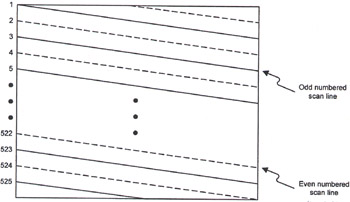
Interlacing preserves the vertical resolution of 525 scan lines and avoids visual...