Videoconferencing and Videotelephony: Technology and Standards, Second Edition
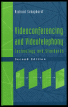
A concise and complete introduction to the design and deployment of standards-based videoconferencing and videotelephony applications.
 TABLE OF CONTENTS
 The bandwidth of the basic analog TV signal is 4 MHz, which although well suited for broadcast TV, video recording, and closed-circuit TV applications, is very incompatible with the world of point-to-point interactive telecommunications such as videoconferencing and videophone. To enable videoconferencing and videophone to become economically practical, the video signal had to be digitized and compressed down to bit rates that are available in standard circuit-switched communication networks such as ISDN. And, since the cost and ubiquity of communication resources is much more favorable at low ISDN bit rates, there has been, and always will be, a strong motivation to reduce the video bit rate to the absolute minimum. A great deal of research and development has been devoted to the topic of video compression, and much success has been achieved. An uncompressed National Television Standards Committee (NTSC) video signal requires a bit rate of at least 90 Mbps. The most common video bit rate employed in videoconferencing systems today is approximately 100 Kbps, yielding a compression ratio of roughly 1,000 to 1. This incredible achievement in video compression has enabled the unfolding revolution of digital television as now implemented in systems such as videoconferencing, satellite TV, HDTV, DVD, and videophone.
This chapter provides an overview of video compression technology. It does not describe particular video coding standards which have been so important to the introduction and explosion of videoconferencing and videophone systems. These video coding standards are presented elsewhere in this book.
The first...