Videoconferencing and Videotelephony: Technology and Standards, Second Edition
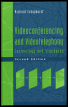
A concise and complete introduction to the design and deployment of standards-based videoconferencing and videotelephony applications.
 TABLE OF CONTENTS
 PCM transmits each pixel as an independent sample without taking advantage of the high degree of pixel-to-pixel correlation existing in most pictures. Predictive coding is a basic bit rate reduction technique that does reduce this pixel-to-pixel redundancy. Figure 3.8 is a block diagram illustrating the basic predictive coding process. A predictor predicts the brightness value of each new pixel based solely upon the pels that have been previously quantized and transmitted. The predictor can vary greatly in complexity. The new pixel can be predicted from the previous pixel in the line, or a block of pixels can be predicted from a block of pixels in the previous video frames. The predicted brightnessvalue is subtracted from the actual brightness value of the new pel resulting in a bipolar prediction error signal. This error signal is quantized and transmitted. This quantization process can vary over a wide range of complexities. The most common technique is conventional pel-by-pel scalar quantization. However, it is also possible to employ transform coding or vector quantization. The quantization can be fixed, or it can adapt to the data itsel . The quantizer can also vary over a wide range of accuracies. If 1-bit quantization is employed, the system becomes the well-known Delta Modulation technique. If the predictive quantizer employs multiple bits per pel, the technique is commonly defined as differential PCM (DPCM). At the receiver the inverse of the quantization process is performed and the decoded error signal is added to the predicted value to...