Videoconferencing and Videotelephony: Technology and Standards, Second Edition
A concise and complete introduction to the design and deployment of standards-based videoconferencing and videotelephony applications.
 TABLE OF CONTENTS
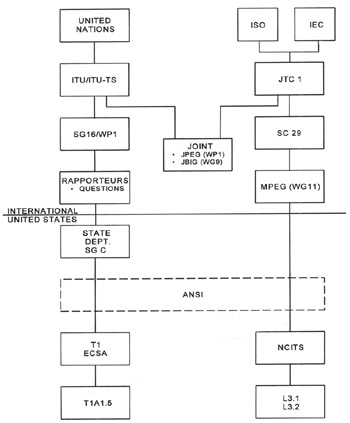
 It has been clearly established that standards are a fundamental necessary step in the provision of effective audiovisual communications. The Group 3 facsimile and H.320 videoconferencing standards are excellent examples. Figure 5.1 illustrates the primary international and U.S. organizations that establish these standards. Section 5.1 focuses on the international standard organizations such as the ITU, ISO, IMTC, SMPTE, IEEE, and IETF. It should be noted that the ITU and ISO organizations are fundamental standard-setting structures in that the basic membership is comprised of countries. In contrast, the IMTC is a consortium of corporations. T1 and NCITS are two key U.S. standard organizations dealing with digital TV standards which are discussed in Section 5.2. The European Telecommunications Standards Institute (ETSI) is a regional standards-setting organization described in Section 5.3.
The ITU is a global intergovernmental treaty organization within which governments and the private sector cooperate to develop recommendations that guide telecommunication service providers and manufacturers of related equipment to offer interoperable telecommunication services. The ITU also allocates radio-frequency spectrum and supports efforts to eliminate harmful interference between radio stations of different specific technical assistance projects funded by the United Nations. These general task outlines are pursued by the ITU viaa three-sector organizational structure reflected in Figure 5.2. Each sector is supported by an ITU bureau headed by a director with general administration managed by a general secretariat all under the secretary-general of the ITU.