Videoconferencing and Videotelephony: Technology and Standards, Second Edition
A concise and complete introduction to the design and deployment of standards-based videoconferencing and videotelephony applications.
 TABLE OF CONTENTS
 Quantization is the process by which an analog signal, having a continuous range of possible values, is divided into a limited set of discrete steps. The most common quantization procedure is scalar, where one can visualize a scale placed next to the variable being measured. In the scalar quantization process, one digital word represents the quantized value of one sample of a signal (for example, the value of a single pixel in an image).
In the case of vector quantization (VQ), one digital word represents the quantized value of more than one sample of a signal. In the case of the VQ of an image [1 9], a single word, or vector, is typically used to represent the quantized values of, for example, an entire 4 X 4 array of pixels. Unfortunately, it is difficult to visualize how one vector represents multiple quantized values in n-dimensional space. It is easier to visualize the vector quantization of an arrayof two adjacent pixels as illustrated in Figure 3.15. The figure shows the case where each pixel is first quantized, by conventional scalar means, to 4-bit (16-level) precision. The figure illustrates one vector representing the combination of brightness value 6 for pixel A and brightness value 9 for pixel B. In general, the vector could take on 16 X 16 = 256 possible values; however, if only this procedure were employed, no compression would be achieved.
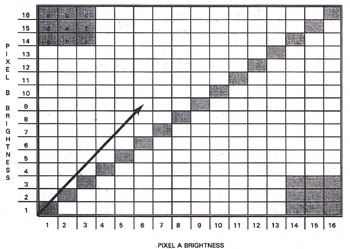
Compression in VQ systems is accomplished in two steps. In the...