Handbook of Thin Film Deposition Processes and Techniques: Principles, Methods, Equipment and Applications, Second Edition

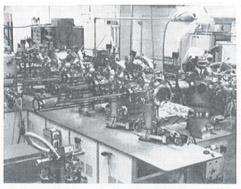
Our attention in this section will focus on III-V MBE equipment. Discussions relevant to silicon and II VI MBE will be made where appropriate. A system for II VI MBE is shown in Fig. 6.
Vacuum system construction practices closely follow those of surface analysis equipment. Standard ultrahigh vacuum (UHV) practices are employed (see Dushman,[94] Guthrie,[95] or O'Hanlon,[96] for example). All internal materials are carefully selected for minimal background gas contribution and 200 C bakeout temperature compatibility. Materials like stainless steel, quartz and alumina are used where operating temperatures do not exceed 200 C. High purity refractory metals and pyrolytic boron nitride (PBN) are commonly used where temperatures exceed 200 C. Moving parts are typically dry-lubricated with very low vapor pressure molybdenum or tungsten disulfide.
System chambers are normally fabricated from either 304 or 316 stainless steel using TIG welding techniques. These are the metals of choice for strength, vacuum compatibility and relative ease of fabrication. Following fabrication, chambers are often electropolished and passivated to improve the surface outgassing. Several techniques are practiced and properly prepared stainless surfaces will have an outgassing rate below 5 10 -11 Torr l/cm 2sec. Post bake levels in the 4 10 -12 Torr l/cm 2sec range are nominal.[97] There has been some recent success constructing MBE systems from aluminum,[98] but aluminum may not be compatible with...