Practical Electronics Handbook, Sixth Edition
Chapter 2: Capacitors

Capacitance

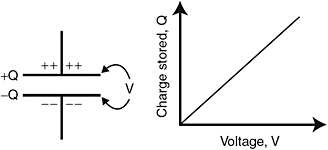
Two conductors that are not connected and are separated by an insulator constitute a capacitor. When a source of EMF such as a cell is connected to such an arrangement, current flows momentarily, transferring change (in the form of electrons) from one conducting plate (the + plate) to the other (Figure 2.1). When a quantity of charge Q (measured in units of coulombs) has been transferred, the voltage across the plates equals the voltage V across the voltage source. For a fixed arrangement of conductors and insulator, the ratio Q/V is a constant called the capacitance, C. The relationship can be written in the three forms:


with V in volts, Q in coulombs and C in farads.


Figure 2.1: Basic principles of the capacitor. The relationship Q/V shown in the graph, is defined as the capacitance, C.

The parallel-plate capacitor

The parallel-plate capacitor is the simplest theoretical (and practical) arrangement and its capacitance value is, for ideal conditions, easy to calculate. For a pair of parallel plates of equal area A, separation d, the capacitance is given by:


The quantity ?? 0 is a universal constant called the permittivity of free space, and it has the fixed value of 8.84 10 ?12 farads per metre. Air has approximately this same value of permittivity also, but other insulating materials have values of permittivity that are higher by the factor ? r, a...

UNLIMITED FREE
ACCESS
TO THE WORLD'S BEST IDEAS

SUBMIT
Already a GlobalSpec user? Log in.

This is embarrasing...

An error occurred while processing the form. Please try again in a few minutes.

Customize Your GlobalSpec Experience

Category: Capacitors
Finish!
Privacy Policy

This is embarrasing...

An error occurred while processing the form. Please try again in a few minutes.