Practical Electronics Handbook, Sixth Edition
Systems that use two or more discrete levels of voltage or current to represent states are referred to as digital. The vast majority of such systems use two levels only, so they are binary in nature. In a binary system the states are usually named TRUE and FALSE; by convention TRUE is equated with 1 (one) and FALSE with 0 (zero).
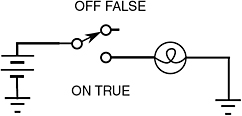
In order to represent these states electrically we could use a switch. When the switch is open no current flows, the zero (0) state, when the switch is closed current flows, representing one (1). Current flow can be indicated by a lamp or a meter (Figure 9.1).
Given that the states of the system can be set, represented and indicated by these simple means we can extend the concept to include decisions based on reason, that is deterministic logic systems.
The basic decision-making logic operations or gates are AND, OR and NOT. These were defined in the 19 th century by the mathematician/philosopher George Boole, hence the name Boolean Algebra given to the system of writing logic equations. The three elementary logic gates are simple but from these even the most complex systems can be built.
Boolean algebra provides a compact representation of logic functions. The notation of Boolean algebra is similar to that of arithmetic, OR is represented as +, AND is represented as . For example A + B C is A OR...