Practical Electronics Handbook, Sixth Edition
Photodiodes

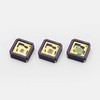
A photodiode can be regarded as a high-impedance non-ohmic photosensitive device whose current is almost independent of applied voltage. The incident light falls on a reverse-biased semiconductor junction, and the separation of electrons from holes will allow the junction to conduct despite the reverse-bias. Photodiodes are constructed like any other diodes, using silicon, but without the opaque coating that is normally used on signal and rectifier diodes. The junction area may be quite large, so the photodiode may have more capacitance between electrodes than a conventional signal diode. This can be compensated by using a feedback capacitor in the circuit, illustrated in Figure 5.6, which shows a typical circuit for using a photodiode along with an operational amplifier for a voltage output. The feedback resistor R will determine the output voltage, which will be RI, where I is the diode current.

  • Some LEDs can be used as photodiodes with peak sensitivity values in the infra-red or in the visible spectrum, and in some circuits it can be convenient to use the same device as both a receiver and an indicator.


Figure 5.6: The output of the photodiode is normally very small, and amplification is almost always needed. Note the diode symbol, which is like the LED symbol but with the arrow s direction reversed.

Characteristics for photodiodes specify the output current into a short circuit, and the current will be much lower into a resistance of appreciable value. The sensitivity can be quoted in terms of incident...

UNLIMITED FREE
ACCESS
TO THE WORLD'S BEST IDEAS

SUBMIT
Already a GlobalSpec user? Log in.

This is embarrasing...

An error occurred while processing the form. Please try again in a few minutes.

Customize Your GlobalSpec Experience

Category: Photodiodes
Finish!
Privacy Policy

This is embarrasing...

An error occurred while processing the form. Please try again in a few minutes.