Practical Electronics Handbook, Sixth Edition
Transistors

Like signal diodes, transistors can be constructed using either silicon or germanium, but virtually all transistors other than exotic types use silicon; the exotic types use compound semiconductors such as gallium arsenide. The design data in this section refer mainly to silicon transistors. Though you may seldom see transistors used as separate components in modern circuits, it is important to know how they work, because they form the basis of the integrated circuits (ICs) that are used in virtually all electronic circuits today. In addition, experimental circuits for which there is no existing IC available have to be made from a combination of ICs and discrete transistors and diodes. See later for a note about digital transistors which have built-in bias resistors.

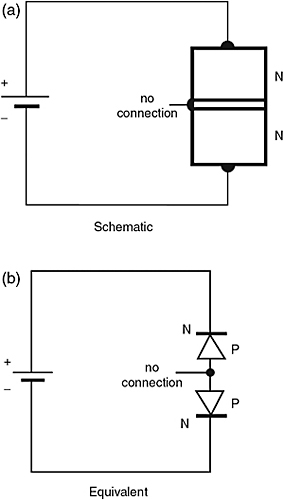
Figure 5.11 shows a schematic outline of the bipolar junction transistor (BJT), one of the two important types of transistor. This is a device that makes use of two junctions in a crystal with a very thin layer between the junctions. The thin layer is called the base, and the type of BJT depends on whether this base layer is made from P-type or from N-type material.


Figure 5.11: (a) Schematic connection of NPN BJT, (b) equivalent diode circuit.

If the base layer is of N-type material, the transistor is a P-N-P type, and if the base layer is of P-type material, the transistor is an N-P-N type. The differences lie in the polarity of power supplies and signals rather than in the way...

UNLIMITED FREE
ACCESS
TO THE WORLD'S BEST IDEAS

SUBMIT
Already a GlobalSpec user? Log in.

This is embarrasing...

An error occurred while processing the form. Please try again in a few minutes.

Customize Your GlobalSpec Experience

Category: Transistors
Finish!
Privacy Policy

This is embarrasing...

An error occurred while processing the form. Please try again in a few minutes.