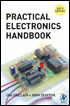
Practical Electronics Handbook, Sixth Edition
The troubleshooting of circuits and systems is a skill that has to be acquired by practice; this chapter is aimed at providing pointers to some common techniques and pitfalls. In order to test a circuit you first have to know what it should do if it is working correctly, and the circumstances under which it is expected to perform to specification. It is also necessary to understand the performance and limitations of the test equipment.
One further point is that wherever mains circuits are involved extra caution and care is essential. It is very easy to kill yourself and others with poor electrical safety. If in doubt get help from someone who is qualified and experienced. Do not assume that experience with electronic circuits provides the experience necessary for dealing with mains voltages. See the section headed Mains work in this chapter.
Good quality test leads make an enormous difference to the speed and efficiency of troubleshooting and testing. A range of standard power connector to 4 mm leads that will plug into a laboratory power supply will ensure safe and easy connection of devices with DC power sockets. Ideally these leads should be clearly colour coded. Where sockets may have either centre pin polarity make sure that the connectors are clearly marked. Signal leads are just as important and using the correct connectors and cable type can often be essential for correct operation of a piece of equipment. It is important too that...