
Linear Limit Switches Information
Switches are electrical devices used to break electrical circuits. Limit switches are essentially switches that can be actuated by an object other than a human operator. Mechanical limit switches use physical contact to detect the presence of an object, while solid state devices use proximity sensors, light sensors, or electric switches. They can be used as control devices for normal machine operation or as emergency switches. Linear limit switches are limit switches which detect and are activated by linear motion.
Limit switches are used to solve a multitude of problems in packaging, manufacturing, motor control, and consumer applications. Within these applications, they can be used to detect presence/absence, speed, position, range of motion, and travel limit, as well as to count discrete objects or events and break a circuit.
Linear limit switches are frequently used to limit the motion of linear actuators. The video below details the operation of a linear actuator equipped with two limit switches. The limit switches are set to switch off the power supply when triggered. Note that because limit switches have been installed at both ends of the actuator, the power supply switches when the actuator is both fully extended or fully retracted.
Video credit: MrActuators / CC BY-SA 4.0
Switch Type
Linear limit switches may use mechanical or solid state means to detect an object and switch a load.
Electromechanical Switches
Electromechanical limit switches use arms, levers, knobs, plungers, or other actuators that make physical contact with another object. When the object contacts the actuator, the switch's contacts either make or break a connection depending on the switch's contact orientation.
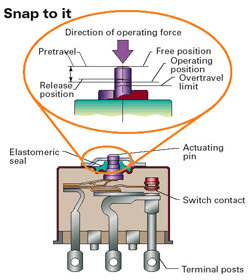
A pin-actuated mechanical switch. Image credit: Haydon Switch and Instrument, Inc.
Because of the physical nature of operation, mechanical limit switches are subject to wear but are often manufactured as extremely rugged devices to compensate. Other advantages include high current switching capability (typically up to 10 A), excellent environmental resilience, and low cost. However, mechanical limit switches may be limited by the need to make physical contact with an object.
Solid State Switches
Solid state limit switches contain no moving parts. They detect objects using an optical sensor or other electronic device, and switch using solid state components such as resistors, capacitors, and transistors. While solid state devices usually have longer operating lives than electromechanical types, they are also more expensive.

A solid state limit switch module. Image credit: Hellotrade
Contact Specifications
Buyers may consider several different specifications related to a switch's contacts, including contact type, normal state, and switch configuration.
Normal State
A limit switch may be normally open (NO) or normally closed (NC) in its normal resting position. A NO device, when actuated, switches to close (or "make") the circuit, whereas an NC switch would open and break the circuit when actuated.
Contact Type
A limit switch may feature one of three different types of contact type.
-
Momentary contact switches remain open or closed only during actuation. For example, a NO switch would close at the first instance of the actuation condition; when this condition ceases, the switch would reopen. Momentary contact is sometimes referred to as spring return.
-
Maintained contact devices maintain their triggered position even after the actuation condition ceases. The contacts must be reset by mechanical action.
-
Positive opening (or positive breaking) contacts remain open in the activated position even in the event of mechanical failure. Positive opening switches are often used in critical safety applications because of their reliability.
Switch Configuration
When selecting a limit switch it is important to understand the switch's poles and throws specifications.
Poles: The term "pole" describes the number of separate circuits controlled by a switch. The number of circuits controlled by the limit switch determines the number of switch contacts, which in turn determines the poles needed to make or break the contacts. Switches typically have between one and four poles.
The image series below illustrates, from left to right, a single pole (SP) and double pole (DP) switch.
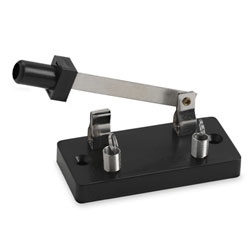
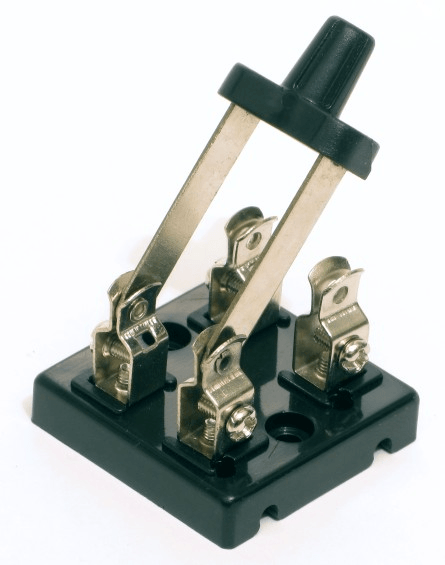
Image credit: Enasco | Skycraft Surplus
Throws: It is also important to consider a limit switch's throws, or the number of distinct positions a switch is capable of.
Single throw (ST) switches are open in one position and closed in another. For example, a single pole single throw (SPST) switch is a simple on-off switch, such as a light switch. A double pole single throw (DPST) switch is an on-off switch that opens and closes two contacts with a single motion.
Double throw (DT) switches are two-way devices. Double throw relays have three contacts and two positions: in the first position, Contacts 1 and 2 are in contact, but the third remains open. In the second position, this connection is reversed to Contacts 2 and 3.
General Specifications
Connection Method
A linear limit switch may use a variety of means to connect to an existing system.
The switch may feature an integral cable for electrical connection.
Certifications / Approvals
A limit switch may be certified or approved by a standards body or other organization.
A Conformité Européenne (CE) mark ensures that a product complies with European Union (EU) legislation and may be placed on the European market. A CE mark is not legally required to certify a product's quality, but often ensures quality in specialty applications such as medical use.

A CE mark. Image credit: MatthiasDD
Underwriters Laboratory (UL) is a U.S. product safety certification organization that develops standards and test procedures for products, materials, components, and tools.
The Canadian Standards Association (CSA) is a comparable standards organization for products manufactured in Canada.
The registered mark of the UL or CSA indicates that a product has been tested and certified to meet the organization's recognized standards.


UL (left) and CSA marks. Image source: ul.com | intertest.net
References
Stephen L. Herman, Industrial Motor Control (USA: Thomson Delmar Learning, 2005), 153-155.
Image credit:
Allied Electronics | Parker Hannifin | Euchner USA
- Adjustable Lever / Leaf
- CE Certification
- CSA Certification
- Double Pole, Double Throw (DPDT)
- Double Pole, Single Throw (DPST)
- Electromechanical
- Enclosed Switch Housing
- Integral Cable
- Maintained Contact
- Momentary Contact
- Normally Closed (NC)
- Normally Open (NO)
- Positive Opening
- Push Roller
- Pushbutton or Plunger
- Rated for Hazardous Locations
- Roller Lever / Leaf
- Rotatable Head
- Screw Terminals
- Self-Cleaning Switch Contacts
- Side Mounted Actuator
- Single Pole, Double Throw (SPDT)
- Single Pole, Single Throw (SPST)
- Solder Terminal
- Solid State
- Spade Terminals
- Standard Lever / Leaf
- TTL Compatible
- Top Mounted Actuator
- UL listed