Methodology for the Digital Calibration of Analog Circuits and Systems: With Case Studies
The successive approximations algorithm allows to find quickly a digital value by dichotomic search. By performing a sequence of comparisons, it converges to the desired value. The algorithm is presented here as a means for calibrating circuits. However, it has other well-known applications, in analog-to-digital converters for example [7].
Let's consider that the DAC of figure 17 is an ideal binary-radix digital-to-analog converter with n bits of resolution. It has a digital input bus D, consisting in n digital inputs (d 1, , d n), where d 1 corresponds to the least significant bit (LSB) and d n to the most significant bit (MSB). The analog output value A of the DAC for each bit is b 1, , b n. They are binary weighted and perfectly linear, and b 1 = 1 arbitrarily. Consequently:
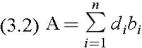
The output of the DAC for a digital input word D is:
with d i = 0 if bit i is cleared, and d i = 1 if bit i is set.
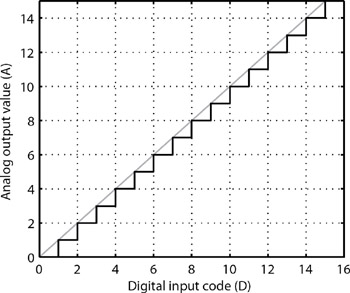
The input/output characteristics of such an ideal DAC with 4 bits (n = 4) is shown in figure 18. The grey line is the identity function y = x.
In the example of section 2, the goal of the algorithm is to find the most suitable digital control value for the DAC which produces the smallest residual offset.
To...