Methodology for the Digital Calibration of Analog Circuits and Systems: With Case Studies
R/2R ladders are a well-known realization of binary-radix digital-to-analog converters. This section briefly introduces R/2R networks. Then, an implementation of R/2R ladders using MOS transistors as pseudo-resistors is studied in sections 8 and 9. Finally, section 10 presents a sub-binary radix version of this ladder, which can be used efficiently for successive approximations.
There are two variants of R/2R DACs. The first one is the voltage-mode network [24], which adds up fractions of a reference voltage to produce a voltage output. The second is the current-mode ladder, which collects split components of a reference current to produce a current output.
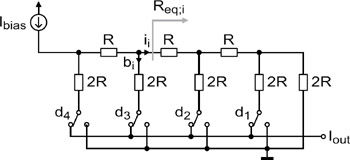
Figure 29 presents a 4 bits current-mode R/2R ladder. It is a regular arrangement of two values of resistors: R between the stages and 2R for each stage and as terminator. In each stage, the current is switched either to the output I out or to a garbage current collector, in this case the ground. The switches are operated by the digital input word D of the DAC. The voltage in the current output node has to be equal to the voltage in the garbage collector, so that switching b i has no effect on the current division in the ladder.
In each stage of the network, the incoming current i i+1 is divided into 2 equal currents b i and i i:
The reason for this symmetrical division is that:
Equation 3.19 can be proven...