Methodology for the Digital Calibration of Analog Circuits and Systems: With Case Studies
10: R/XR LADDERS

10 R/XR LADDERS

A high-precision DAC is not necessary to perform successive approximations. With only a slight modification, it is though possible to make the ladder sub-binary and to relax the design constraints.

10.1 Principle

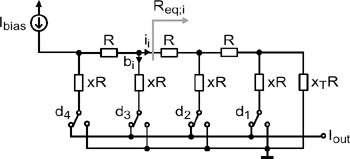
Figure 39 presents a 4-stages R/xR ladder, which is a generalization of the R/2R ladder.


Figure 39: R/xR ladder

The resistor in the vertical branches has here a value xR, and the terminator x TR. The case with


corresponds to the R/2R ladder. On the opposite, choosing


makes the converter sub-binary. This special case is analyzed below. A theoretical study of the R/xR structure can be found in [36]. Here, a more circuit-oriented analysis is done.

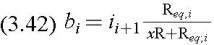
In each stage of the network, the incoming current i i+1 is divided into 2 currents b i and i i:


with


and


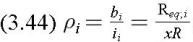
More interesting is the ratio ? i between these two currents:


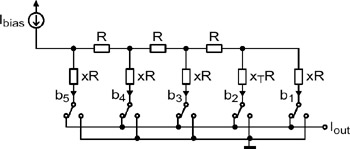
In fact, this ratio can be used to derive the condition which allows the ladder to be used for successive approximations. Let's make two small modifications in the ladder: Using the terminator current as a bit in the converter instead of dumping it, and numbering the bits by taking care to exchange the last two currents to have:


and


Figure 40 shows the resulting circuit.


Figure 40: Modified R/xR ladder =

10.2 Working Condition

In each stage of the ladder in figure 40, the remaining current i i is equal to the sum of the less significant bits:

UNLIMITED FREE
ACCESS
TO THE WORLD'S BEST IDEAS

SUBMIT
Already a GlobalSpec user? Log in.

This is embarrasing...

An error occurred while processing the form. Please try again in a few minutes.

Customize Your GlobalSpec Experience

Category: Digital-to-Analog Converter (DAC) Chips
Finish!
Privacy Policy

This is embarrasing...

An error occurred while processing the form. Please try again in a few minutes.