Practical Power System Protection
Providing both the underpinning knowledge and basic calculations needed to understand, specify, use and maintain power protection systems, this book also covers the practical techniques required on a daily basis.
 TABLE OF CONTENTS
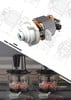
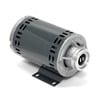
 Electric motors are the workhorses of industry and are extensively used to convert electrical energy into rotational mechanical energy. Squirrel cage induction motors, particularly the TEFC type (Totally enclosed, fan cooled), have become extremely popular mainly because of their simple, rugged construction and good starting and running torque characteristics. For example, in a small country such as South Africa, about 100 thousand of this type of motor above 1 kW are sold annually, mainly for new applications but also as replacements for worked out or 'burnt out' motors. The TEFC design improves the mechanical life of the motor because dust and moisture are excluded from the bearings and windings. This type of motor has proved to be extremely reliable with an expected lifetime of up to 40 years when used in the correct application.
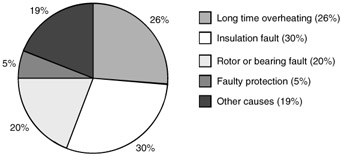
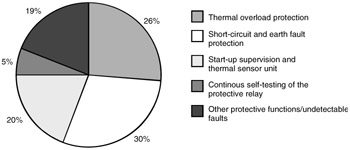
The causes of motor damage given in Figure 17.1 are taken from statistics gathered within the ABB Group. They are shown in Figure 17.2, that 81% of these failures could have been avoided by using an accurate and effective relay.
The life of an electric motor is determined by the shorter of the following two factors:
Mechanical life: This is the life of the mechanical parts such as bearings, shaft, fan and the frame and depends on the environment (dust, moisture, chemicals, etc.), vibration and lubrication. The mechanical life can be extended...