Practical Power System Protection
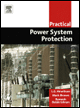
Providing both the underpinning knowledge and basic calculations needed to understand, specify, use and maintain power protection systems, this book also covers the practical techniques required on a daily basis.
 TABLE OF CONTENTS
 The operation of monitoring devices like relays and the tripping mechanisms of breakers require independent power source, which does not vary with the main source being monitored. Batteries provide this power and hence they form an important role in protection circuits.
The relay/circuit breaker combination depends entirely on the tripping battery for successful operation. Without this, relays and breakers will not operate, becoming 'solid', making their capital investment very useless and the performance of the whole network unacceptable.
It is therefore necessary to ensure that batteries and chargers are regularly inspected and maintained at the highest possible level of efficiency at all times to enable correct operation of relays at the correct time.
A battery is an assembly of cells. Whether it is used to make a call using mobile phone or to trip a circuit breaker, every cell has three things in common - positive and negative electrodes and an electrolyte. Whereas some of the dry cell batteries drain out their energy and are to be discarded, a stationary or storage battery used in the switchgear protection has the capability to be recharged.
There are two types of batteries used in an electrical control system:
Lead acid type
Nickel cadmium type.
Both the above types can be classified further into flooded type and sealed maintenance free type. The flooded cell construction basically refer to the electrodes of the cell in the electrolyte medium, which can be topped up with...