Practical Power System Protection
Providing both the underpinning knowledge and basic calculations needed to understand, specify, use and maintain power protection systems, this book also covers the practical techniques required on a daily basis.
 TABLE OF CONTENTS
 A generator is the heart of an electrical power system, as it converts mechanical energy into its electrical equivalent, which is further distributed at various voltages. It therefore requires a 'prime mover' to develop this mechanical power and this can take the form of steam, gas or water turbines or diesel engines.
Steam turbines are used virtually exclusively by the main power utilities, whereas in industry three main types of prime movers are in use:
Steam turbines: Normally found where waste steam is available and used for base load or standby.
Gas turbines: Generally used for peak-lopping or mobile applications.
Diesel engines: Most popular as standby plant.
Small- and medium-sized generators are normally connected direct to the distribution system, whilst larger units are connected to the EHV grid via a transformer (see Figures 18.1 and 18.2).
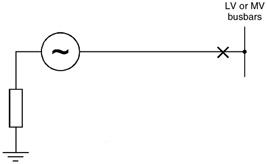
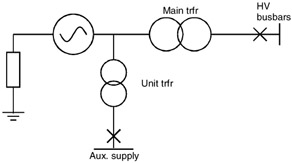
It will be appreciated that a modern large generating unit is a complex system, comprising of number of components:
Stator winding with associated main and unit transformers
Rotor with its field winding and exciters
Turbine with its boiler, condenser, auxiliary fans and pumps.
Many different faults can occur on this system, for which diverse protection means are required. These can be grouped into two categories:
| Electrical | Mechanical |
|---|---|
| Stator insulation failure | Failure of prime mover |
| Overload | Low condenser vacuum |
| Overvoltage | Lubrication oil failure |
| Unbalanced load | Loss of boiler firing |
| Rotor faults | Over speeding |
| Loss of excitation | Rotor distortion |
| Loss... |