Practical Power System Protection
Providing both the underpinning knowledge and basic calculations needed to understand, specify, use and maintain power protection systems, this book also covers the practical techniques required on a daily basis.
 TABLE OF CONTENTS
 When a consumer requests electrical power from a supply authority, ideally all that is required is a cable and a transformer, shown physically as in Figure 2.1.
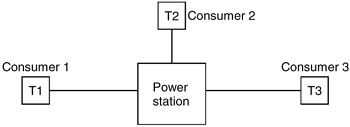
This is called a radial system and can be shown schematically in the following manner (Figure 2.2).
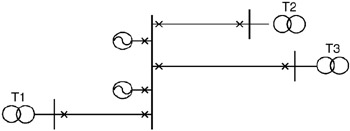
If a fault occurs at T2 then only the protection on one leg connecting T2 is called into operation to isolate this leg. The other consumers are not affected.
If the conductor to T2 fails, then supply to this particular consumer is lost completely and cannot be restored until the conductor is replaced/repaired.
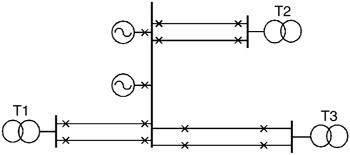
This disadvantage can be overcome by introducing additional/parallel feeders (Figure 2.3) connecting each of the consumers radially. However, this requires more cabling and is not always economical. The fault current also tends to increase due to use of two cables.
The Ring main system, which is the most favored, then came into being (Figure 2.4). Here each consumer has two feeders but connected in different paths to ensure continuity of power, in case of conductor failure in any section.
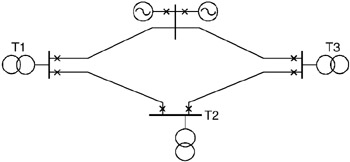
Essentially, meets the requirements of two alternative feeds to give 100% continuity of supply, whilst saving in cabling/copper compared to parallel feeders.
For faults at T1 fault current is fed into fault via two parallel paths...