Practical Power System Protection
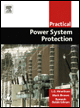
Providing both the underpinning knowledge and basic calculations needed to understand, specify, use and maintain power protection systems, this book also covers the practical techniques required on a daily basis.
 TABLE OF CONTENTS
 Before selecting proper protective devices, it is necessary to determine the likely fault currents that may result in a system under various fault conditions. Depending upon the complexity of the system the calculations could also be too much involved. Accurate fault current calculations are normally carried out using an analysis method called symmetrical components. This method is used by design engineers and practicing protection engineers, as it involves the use of higher mathematics. It is based on the principle that any unbalanced set of vectors can be represented by a set of three balanced quantities, namely: positive, negative and zero sequence vectors.
However, for general practical purposes for operators, electricians and men-in-the-field it is possible to achieve a good approximation of three-phase short-circuit currents using some very simple methods, which are discussed below. These simple methods are used to decide the equipment short-circuit ratings and relay setting calculations in standard power distribution systems, which normally have limited power sources and interconnections. Even a complex system can be grouped into convenient parts, and calculations can be made groupwise depending upon the location of the fault.
It is interesting to note that nearly all problems in electrical networks can be understood by the application of its most fundamental law viz., Ohm's law, which stipulates,
For DC systems

For AC systems

Vectors are a most useful tool in electrical engineering and are necessary for analyzing AC system components like voltage, current and power, which...