Practical Power System Protection
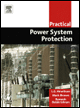
Providing both the underpinning knowledge and basic calculations needed to understand, specify, use and maintain power protection systems, this book also covers the practical techniques required on a daily basis.
 TABLE OF CONTENTS
 A power system is not only capable to meet the present load but also has the flexibility to meet the future demands. A power system is designed to generate electric power in sufficient quantity, to meet the present and estimated future demands of the users in a particular area, to transmit it to the areas where it will be used and then distribute it within that area, on a continuous basis.
To ensure the maximum return on the large investment in the equipment, which goes to make up the power system and to keep the users satisfied with reliable service, the whole system must be kept in operation continuously without major breakdowns.
This can be achieved in two ways:
The first way is to implement a system adopting components, which should not fail and requires the least or nil maintenance to maintain the continuity of service. By common sense, implementing such a system is neither economical nor feasible, except for small systems.
The second option is to foresee any possible effects or failures that may cause long-term shutdown of a system, which in turn may take longer time to bring back the system to its normal course. The main idea is to restrict the disturbances during such failures to a limited area and continue power distribution in the balance areas. Special equipment is normally installed to detect such kind of failures (also called 'faults') that can possibly happen in various sections of a system, and...