Chemical Engineers' Portable Handbook

Emphasizing practice-oriented design and approaches, this guide offers a presentation of the salient and important aspects of chemical engineering for practicing professionals.
 TABLE OF CONTENTS
 Chemical reactions take place because of chemical affinity. The reaction rate r in general is
| (6-1) | 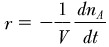 |
where n A is moles of reactant A, V is volume, and t is time. If the volume is constant
| (6-2) |  |
where C A is the concentration of reactant A in moles per volume.
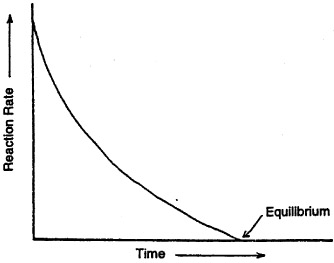
Chemical reactions proceed at a rate r, reaching a condition of equilibrium at which the rate approaches zero asymptotically on a plot of rate versus time (Figure 6-1).
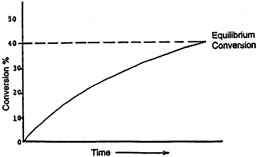
On a plot of conversion versus time, equilibrium occurs at the final percentage conversion attained. It indicates the likelihood that a reaction will produce an appreciable amount of product (Figure 6-2).
Hence, chemical equilibrium calculations are important when evaluating chemical reactions. A chemical equilibrium constant K a is defined by the relationship
| (6-3) |  |
where ? G is the change in Gibbs free energy between products and reactants at a standard state. K a can be defined by its relation to activities. If a reaction can be written as
| (6-4) |  |
then the equilibrium constant K a in terms of activities is
| (6-5) | 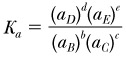 |
where activity is represented by a.
The chemical...