Chemical Engineers' Portable Handbook

Emphasizing practice-oriented design and approaches, this guide offers a presentation of the salient and important aspects of chemical engineering for practicing professionals.
 TABLE OF CONTENTS
 In certain systems relative volatilities are close to unity. As such they represent cases that are extremely difficult to separate. When this occurs either extractive or azeotropic distillation can be used.
The former involves adding a third component that imbalances the relative volatilities and allows separation to take place. Table 5-5 lists some extractive agents with respective binary pairs.
| Binary System | Extractive Agent |
|---|---|
| Hydrochloric acid-water | Sulfuric acid |
| Nitric acid-water | Sulfuric acid |
| Ethanol-water | Glycerin |
| Butane-butene | Acetone or furfural |
| Butadiene-butene | Acetone or furfural |
| Isoprene-pentene | Acetone |
| Toluene-paraffinic hydrocarbons | Phenol |
| Acetone-methanol | Water |
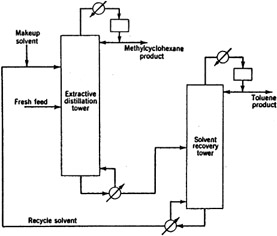
A typical flow sheet for toluene-methylcyclohexane (phenol is the extractive agent) is given in Figure 5-19.
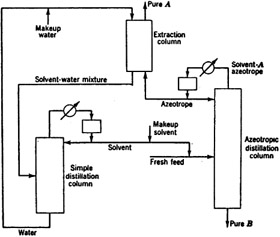
The other type of distillation (azeotropic) involves the creation of an azeotrope that allows the separation to take place. Frequently solvent extraction has to be employed in addition to distillation. Figure 5-20 gives a typical flow sheet.
More detailed discussions of both extractive and azeotropic distillation can be found in references 39 42.