Chemical Engineers' Portable Handbook

Emphasizing practice-oriented design and approaches, this guide offers a presentation of the salient and important aspects of chemical engineering for practicing professionals.
 TABLE OF CONTENTS
 Control is the organization of a function for a specific purpose. Control systems (which change with time) are information processing devices that receive information, act on it, and generate an output. These systems are integrated and, as such, require a systems approach.
Process control systems meet three main needs: (1) minimizing and regulating the influence of external disturbances, (2) guaranteeing a stable process, and (3) optimizing process performance.
There are two categories of control systems: servomechanisms and regulators. Servomechanisms change an output variable; regulators hold an output variable constant even if the input variable changes. Typical servomechanisms are those used for missile guidance or steering. Most chemical or petroleum process control systems are regulators. A chemical application that resembles a servomechanism is a program-controlled batch process using a preset pattern.
Regulators, in turn, can be of two different types (see Figure 7-1), feedback and feedforward.
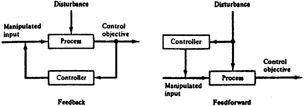
Feedback control is much more widespread than feedforward control. Some cases where the latter is used are shown in Table 7-1.
| Process | Disturbances | Manipulated Variables |
|---|---|---|
| Heat exchanger | Flow rate and temperature of liquid entering tubes | Steam pressure for shell side |
| Drum boiler | Steam flow and feedwater flow | Feedwater flow |
| Distillation column | Feed flow rate and composition | Reboiler steam pressure and reflux |
| Continuous-flow stirred tank reactor | Inlet concentration and temperature | Product removal rate and coolant flow rate |
All control systems have a variable that we...