Chemical Engineers' Portable Handbook

Emphasizing practice-oriented design and approaches, this guide offers a presentation of the salient and important aspects of chemical engineering for practicing professionals.
 TABLE OF CONTENTS
 The practicing chemical engineer must be skilled not only in the physical, mathematical, and engineering sciences but also in applied economics. This last named area enables the chemical engineer to make sound decisions with regard to equipment, processes, and entire plants.
A basic inherent to any treatment of applied economics is the time value of money. There are three types of values that are used: the present worth or value ( P); the future value ( S); and annualized payments ( R). All three are interrelated.
For example
| (8-1) | 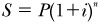 |
where S is the future value of P, the principal invested at an interest rate i for n periods. The units of the interest rate and the number of periods n must match (per year, per week, or per day).
The time value of money is annualized by the following equation in which S is
| (8-2) |  |
in which S is related to R (uniform payment for n periods). Equation 8-2 is abbreviated as
| (8-3) | 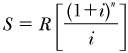 |
The bracketed term is the series compound-amount factor, which enables us to convert annual costs to future costs and vice versa.
Sometimes it is useful to know the present value of a stream of payments instead of the future value. The present value is
| (8-4) | 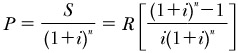 |
where P is the present value. The bracketed term is called the series present-value factor.
The reciprocal of equation 8-4 can tell us the annual payment R