Chemical Engineers' Portable Handbook

Emphasizing practice-oriented design and approaches, this guide offers a presentation of the salient and important aspects of chemical engineering for practicing professionals.
 TABLE OF CONTENTS
 The American Institute of Chemical Engineers (A.I.Ch.E.) defines the profession as:
Chemical engineering is the profession in which a knowledge of mathematics, chemistry and other natural sciences gained by study, experience and practice is applied with judgement to develop economic ways of using materials and energy for the benefit of mankind.
Further, the profession requires "the application of the physical sciences together with economics...to fields that pertain directly to processes and process equipment."
Chemical engineering also can be characterized as a blending of chemistry and mechanical engineering.
The solution of problems in chemical engineering, as indeed in all of the scientific and engineering disciplines, is governed by a simple but powerful protocol:
Determine the problem.
Gather relevant data and information.
Develop a plan.
Execute the plan; but continue to feed back to 1 and 2 above to find if there are any significant changes.
Evaluate the results and develop conclusions.
Processes can be characterized by flow sheets. Such sheets indicate the process pathways. In addition to flows in and out of a unit there are also some special patterns.
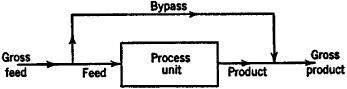
One of these is the bypass stream.
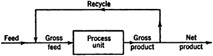
Another widely used system is the recycle.
Finally, there are purge streams.

Overall flow diagrams can be qualitative (Figure 1-4), quantitative (Figure 1-5), or combined-detail (Figure 1-6).