Chemical Engineers' Portable Handbook

Emphasizing practice-oriented design and approaches, this guide offers a presentation of the salient and important aspects of chemical engineering for practicing professionals.
 TABLE OF CONTENTS
 As with heat transfer, we are limited in the analytical solutions we can determine. The net result is that in order to deal with complex flows, geometrics, etc., we use the concept of a mass transfer coefficient.
Unlike the case with heat transfer coefficients, we have a number of mass transfer coefficients (these depend on the driving forces chosen).
| (5-6) | 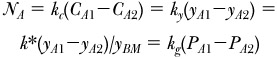 |
The k c, k y, k*, and k g are all mass transfer coefficients that, respectively, have units of centimeters per second, gram-moles per second-square centimeter, gram-moles per second-square centimeter, gram-moles per second-square centimeters-atmosphere. The P As are partial pressures for component A, and y BM is the logarithmic mole fraction of the nondiffusing component,
| (5-7) |  |
The mass transfer coefficient, like its counterpart the heat transfer coefficient, is related to dimensionless groups. One of these groups is the Reynolds number. Another is a mass transfer group that plays the same role as the Prandtl number. This new group is defined as the Schmidt number, Schmidt number (Sc) = momentum diffusivity/mass diffusivity
| (5-8) |  |
Mass transfer Nusselt numbers are then functions of Re, Sc, and L/ D.
| (5-9) | 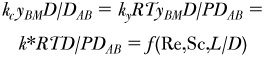 |
As mentioned earlier, the transfer of heat and mass are analogous for similar geometries, boundary conditions, and flows. For example (1),
| (5-10) |  |
where j D, the mass transfer flux, is equal to j H, the heat transfer flux,
| (5-11) |  |
and
| (5-12) |  |
This identity holds for the flow over flat plates,...