HF Radio Systems & Circuits
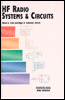
Written for the engineer working in radio communications, regardless of frequency, this comprehensive reference book explains the design of high frequency communications systems and equipment.
 TABLE OF CONTENTS
 Intermediate frequency filters are used in SSB receivers and exciters to shape the desired signal spectrum and to reduce unwanted signals. Unwanted signals are created by the mixing process when a signal frequency is mixed, or translated, to a different frequency. The desired signal may be shaped by filter design to conserve bandwidth and to prevent adjacent channel interference. Filters also protect receiver stages from overload by strong signals on nearby frequencies. In addition, the filtering must not unduly alter the characteristics of the modulated signal. These alterations show up as distortion in the frequency domain (intermodulation and harmonic distortion) or in the time domain (signal delay differences). These effects must be minimized.
The SSB IF filters differ from other bandpass filters because they are offset from the carrier frequency and have a nonsymmetrical attenuation response. These filters are designed to pass one sideband such as USB and reject LSB. Other IF filters have the signal frequency centered in the passband and are used to reduce spurious signals generated by the mixers. Such niters have a symmetrical response.
Since bandpass filters share certain common characteristics, it is desirable to define the various terms associated with them. A diagram of these is shown in Figure 6.1.

Passband The passband defines the limits of the desired signal modulation and is usually defined between the 3-dB points (or half-power points) referenced to the highest peak...