HF Radio Systems & Circuits
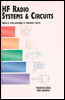
Written for the engineer working in radio communications, regardless of frequency, this comprehensive reference book explains the design of high frequency communications systems and equipment.
 TABLE OF CONTENTS
 Although wideband receiver front ends are in increasing use, they cannot handle situations with very strong off-channel signals. Passive tuned circuit filters are still needed to protect against cross-modulation, IM, damage, and other interference effects. The trend is toward separately packaged preselector filter units using sophisticated tuning and control methods. Selectivity, noise figure degradation, and maximum interference voltage are important constraints. It is possible to design filters with an optimal trade-off of these parameters for given component limitations. With some forethought in the filter design, several preselectors can be driven by the same antenna in a multicoupling configuration.
The same filters or similar circuits can be employed as postselectors to filter the transmitter signal before final power amplification, thus reducing its out-of-band noise and spurious emissions that could interfere with nearby receivers.
A receiver preselector is a passive, tuned filter used between the antenna and the receiver input. It provides additional selective filtering that prevents or reduces the numerous interference and damage problems resulting from collocation of transmitters and receivers, as discussed in detail in Chapter 2. The interference problems that preselectors reduce include IM, cross-modulation, reciprocal mixing, desensitization, spurious and image responses, and circuit overload damage. These problems occur when adequate antenna separation is not available, such as aboard aircraft, ships vehicles, and transportable communication shelter units, or in crowded fixed-station sites. It is common to find isolation between two HF antennas on an aircraft of less than...