HF Radio Systems & Circuits
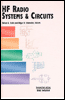
Written for the engineer working in radio communications, regardless of frequency, this comprehensive reference book explains the design of high frequency communications systems and equipment.
 TABLE OF CONTENTS
 This chapter will present the results of the evolution of receiver design with emphasis on the circuits, components, and techniques that are important for SSB reception.
The block diagram and circuit of any receiver are strongly if not totally determined by the available components. Wave-filtering components having sufficient selectivity to select SSB signals are available only with fixed center frequency designs. Therefore, the standard receiver design for HF SSB has become the superheterodyne which uses frequency translation to convert the HF signal to a fixed intermediate frequency where selectivity is practically obtainable. The modem superheterodyne receiver will typically use several intermediate frequencies to obtain selectivity for image and spurious signal rejection in addition to sideband selection. An advantage of the superheterodyne is that the majority of the gain needed to amplify picowatt signal levels to the level needed for human audibility can be constructed and controlled in the fixed-IF circuits. Constant-frequency amplifiers are generally better behaved in the areas of gain stability, noise figure, and distortion.
The technical, physical, and cost requirements of receivers are as varied and complex as there are applications and users. However, there are several basic requirements, plus service and special needs, that commonly enter into the design of a receiver, be it simple or complex. It is helpful and necessary to understand the basis for the technical needs, and to know the range of values to be expected in each parameter. First, the basic requirements will...