HF Radio Systems & Circuits
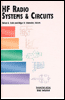
Written for the engineer working in radio communications, regardless of frequency, this comprehensive reference book explains the design of high frequency communications systems and equipment.
 TABLE OF CONTENTS
 The principal task that confronts a radio communications link between two or many mutually distant points is to provide, within the framework of a limited available transmitter power, reliable, high-quality communication. Very often, real-time voice contact is desired. Opposing this goal are the inimical characteristics of the radio frequency (RF) spectrum. Among these are noise from the ionosphere and the galaxy, artificially produced electrical noise, severe variations in the received signal strength (fading) that are observed over time spans from milliseconds to hours or days, propagation disturbances, interference from other users of the spectrum, and multiple arrivals of the signal along different paths. Interference caused to other users is aggravated by technical limitations in transmitter spectral purity and directional antenna design. Interference experienced from other users is increased by deficiencies in receiver design and receiving antennas. One especially difficult mode of interference is between transmitters and receivers that are in close proximity (collocated). Also involved here is the creation of false signals (intermodulation or IM) due to nonlinearities within the collocated environment.
The approach to reliable communication used by radio engineers is to obtain from a given amount of available transmitter power the maximum amount of intelligibility of a speech signal or the minimum error rate of a digital signal (at the distant receiver) under the conditions described above. Two important constraints in this design are the conservation of bandwidth and time. That is, the spectrum in use very often requires a small...