HF Radio Systems & Circuits
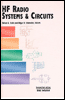
Written for the engineer working in radio communications, regardless of frequency, this comprehensive reference book explains the design of high frequency communications systems and equipment.
 TABLE OF CONTENTS
 This chapter describes transmitting tube circuits because tubes still provide the most practical and economical means of achieving the high performance necessary for multichannel (ISB) transmission at power levels above 1 kW (at present). The opening section provides a good discussion of IMD. This chapter will then show how to choose and compute tube-operating conditions. Tank circuit and coupling network requirements will be discussed, and neutralization and stabilization circuits will be shown. Finally, RF feedback circuits will be described as an effective means of improving IMD performance.
High-power HF communication transmitters are typically designed to accommodate four 3-kHz voice channels in a 12-kHz band allocation. Each 3-kHz channel may carry voice or up to 16 RTTY or data tones. Intermodulation distortion can produce objectionable background "splatter" in voice channels in full-duplex operation. The IMD should be at least 40 dB below the voice signal level for a good-quality circuit. LINCOMPEX (Chapter 7) can be employed to reduce the apparent background noise by about 15 dB. This would practically eliminate any problem with IMD. LINCOMPEX achieves this advantage by compressing the SSB signal amplitude before transmission so that the weaker sounds are transmitted at a much higher level. The amount of compression used is transmitted to the receiver by the absolute frequency of a tone above the audio band. The receiver uses this compression information to change the receiver gain in an inverse manner to reduce the weak sound back to its original relative level.