HF Radio Systems & Circuits
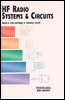
Written for the engineer working in radio communications, regardless of frequency, this comprehensive reference book explains the design of high frequency communications systems and equipment.
 TABLE OF CONTENTS
 When a transmitter and receiver are operating simultaneously in close proximity, there are several ways in which receiver operation may be degraded. Considering receiver limitations, the most severe degradation is receiver burnout, or more likely, opening of a protective antenna relay. A second is desensitization or blocking caused by overload of the receiver front-end circuits. Somewhat related is cross-modulation, which is a transferal, due to receiver nonlinearity, of transmitter modulation to that of the received signal. Reciprocal mixing may occur, a phenomenon that utilizes a strong out-of-band signal to heterodyne local oscillator noise sidebands into the receiver IF passband. Finally, higher-order mixing products, discussed in Chapter 4, "Receiver Design," may result in spurious responses to strong unwanted signals. Transmitter limitations that may degrade collocated receiver operation include harmonic and intermodulation distortion products and broadband noise components that fall within the receiver passband.
A special problem may arise when two transmitters are in operation at the same time in the vicinity of a receiver. First, coupling between the two transmitting antennas transfers some of the power from one transmitter to the other. This transferred power is reflected to the PA output where it intermodulates with its signal to create new frequencies, one of which may fall within the receiver passband. This phenomenon is known as back-intermodulation (back-IM). Second, these two transmitted signals, even if they do not create back-IM, may create IM distortion in the receiver front end. Since the same two frequencies are involved, these...