HF Radio Systems & Circuits
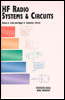
Written for the engineer working in radio communications, regardless of frequency, this comprehensive reference book explains the design of high frequency communications systems and equipment.
 TABLE OF CONTENTS
 Performance measurements are an important and necessary part of the design and development of SSB receivers. Since theoretical predictions and analyses are often difficult to achieve, measurements ensure conformance to the design specifications. This chapter discusses many of the measurement techniques used in designing and testing SSB receivers.
Many of the performance characteristics of receivers are related to two fundamental parameters. These are the internally generated noise and the nonlinearity of the transfer characteristics. Whereas past design emphasis has been on low-noise front ends for the reception of weak signals, today's spectral environment of large transmitter and jammer signals has focused attention on intermodulation (IM) products which may mask small desired signals.
To analyze the noise performance of a receiver (see references [1] and [2]), the receiver may be thought of as a set of two-port networks (or two-ports, for short) in cascade. These two-port networks are filters, amplifiers, mixers, and attenuators. In addition to its desired function of amplification or frequency translation, each two-port generates internal noise and distortion that contaminates the desired signal output.
A simple resistor is a one-port network which may be analyzed as a voltage source (thermal noise) in series with source resistance. The thermal noise source voltage, calculated from noise-power spectral density, is given by

| where n | = noise power density, ?174 dBm in a 1-Hz bandwidth |
| k | = Boltzmann's constant, 1.37 10 ?23 J/K |
| T | =... |