The Linear and Digital Integrated Circuits Design Primer

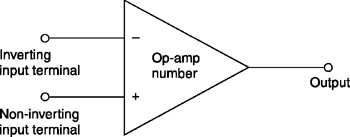
An operational amplifier, or op-amp, is basically a differential amplifier, i.e. it is used for amplifying the difference between two inputs. There are two signal input terminals and one signal output terminal. The input terminals are referred to as inverting input terminal (noted with a ? symbol) and non-inverting input terminal (noted with a + symbol). (See Figure 3.1.)
The operational portion of the name comes from the fact that it can do any mathematical operation such as addition, subtraction, multiplication, division, logarithms, anti-logarithms, differentiation, and integration.
The symbol of an op-amp can be drawn as a triangle with the inputs on one side and the output on the opposite side.
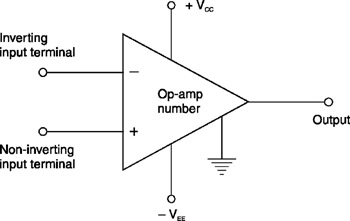
If the power supply is to be included, the symbol can be drawn as shown in Figure 3.2.
With regard to power supply, the op-amp has three terminals: one positive (+ V CC), one negative ( ? V EE), and one ground.
There are certain properties that an ideal op-amp should have. The ideal op-amp characteristics are described below.
Infinite input impedance. If the input current is zero, then any signal source can drive this device.
Zero output impedance. If the op-amp has zero output impedance, then the output voltage will be independent of the load resistance. Therefore, a single op-amp can drive many other devices.