4.3 SUMMER
In a summer, or summing amplifier, many inputs are given and the output is taken from the op-amp. If the inputs are given to the inverting input, then the configuration is an inverting summing amplifier. If the inputs are given to the noninverting input, then the configuration is a non-inverting summing amplifier.
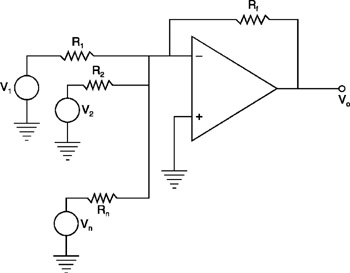 Figure 4.6: Inverting Summer.
 By applying the superposition theorem, it is easy to understand the operation of this circuit.
Assuming the effect due to input V 1, the output V o1 can be written as
| (4.18) | 
|
Similarly the output V o2, due to input V 2, can be written as
| (4.19) | 
|
Similarly, the output V on, due to input V n, can be written as
| (4.20) | 
|
The total output V 0 of the system is the sum of the outputs due to individual inputs.
Substitute from equations (4.18), (4.19) and (4.20):
or
| (4.21) | 
|
As a special case, if R 1 = R 2 =...= R n = R, then
| (4.22) | 
|
which is the sum of all inputs, multiplied by  .
.
| (4.23) | 
|
which is the sum of all input voltages.
| (4.24) | 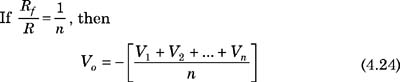
|
where the output is the average of all input voltages.


 TABLE OF CONTENTS