The Linear and Digital Integrated Circuits Design Primer

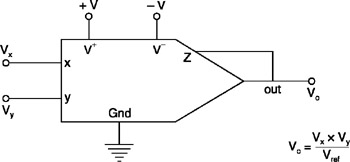
In general, a multiplier is shown with the basic schematic symbol in Figure 4.12.
The output voltage can be written as
| (4.36) | |
| where | V x and V y are input signals |
| and | V ref is a reference voltage that is normally set to 10 volts. |
If both inputs are positive, then the multiplier is called a one-quadrant multiplier. If one input is kept at a positive value and the other input is allowed to take either a positive or negative value, then it is called a two-quadrant multiplier. If both the inputs are allowed to take either positive or negative values, then it is called a four-quadrant multiplier.
There are some commercially available multiplier ICs and multiplier circuits can be constructed from op-amp ICs such as 741.
The applications of multipliers include frequency doubling, frequency shifting, phase angle detection, real power computation, and squaring signals.
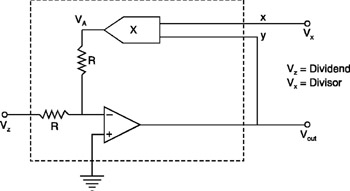
A divider uses the multiplier in the feedback as shown in Figure 4.13.
V out can be written as
| (4.37) | |
The applications of dividers include taking square root and dividing one number by another.