The Linear and Digital Integrated Circuits Design Primer

Chapter 8: Fundamentals of Digital Systems

8.1 INTRODUCTION

Digital Circuits. A digital signal is defined as a signal that has one of two possible states, either logic-0 or logic-1.

Digital circuits have digital signals for both input and output.

8.2 NUMBER SYSTEMS AND CONVERSION

A system in which there are only two output states is called a binary system. The value is either 0 or 1.

Conversion from Decimal System to Binary System

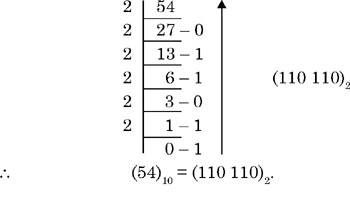
  1. Full Number. The given number is divided by 2 and the quotient and the remainder are noted. Then the quotient is divided by 2. This is done until the quotient becomes 0. Then by writing the remainders in order from the last remainder to the remainder from the first division, the binary equivalent of the given decimal is seen.

    Let us consider the example of (54) 10


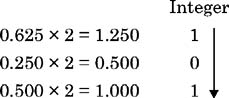
  2. Fraction. The given fraction is multiplied by 2, until the fraction becomes 0. The integers of each product are noted and are removed from the next stage of multiplication. Finally, the integers are written in order to get the binary equivalent.

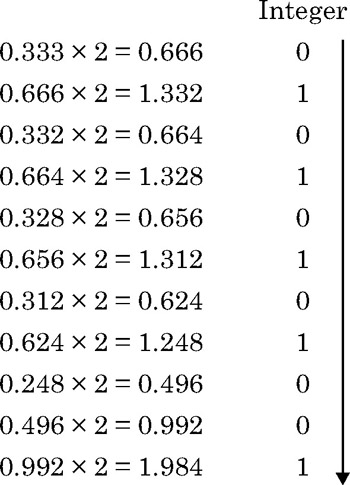
    If irrational fractions are to be converted into equivalent binary fractions, then the process is stopped, after noting that the fractions got in multiplication are repeated successively.

    Let us consider the example of (0.625) 10.


    Therefore, (0.625) 10 = (0.101) 2

    Let us consider another example of (0.333) 10.


    Since the series is not converging, we can approximate:


  3. Mixed Number. When dealing with a fraction and an integer,...

UNLIMITED FREE
ACCESS
TO THE WORLD'S BEST IDEAS

SUBMIT
Already a GlobalSpec user? Log in.

This is embarrasing...

An error occurred while processing the form. Please try again in a few minutes.

Customize Your GlobalSpec Experience

Category: Digital-to-Analog Converters
Finish!
Privacy Policy

This is embarrasing...

An error occurred while processing the form. Please try again in a few minutes.