The Linear and Digital Integrated Circuits Design Primer

Chapter 7: DACs and ADCs

7.1 BASIC PRINCIPLES

Many measuring systems measure in analog form and all the physical quantities exist in analog form. Today, however, all the processing is done through computers which use digital technology. Hence, there is a need to convert analog data to digital data and vice versa.

This is why we need Digital to Analog Converters (DAC) and Analog to Digital Converters (ADC). As a group, they are Data Converters.

7.2 TECHNIQUES FOR DACs


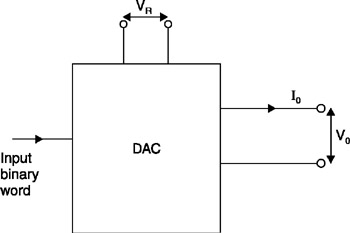
Figure 7.1: Digital to analog convertor block diagram.

The DAC output can be either in the form of current I 0 or in the form of voltage V 0.

For this example, output in voltage is considered. The output voltage can be written:

(7.1)

where V 0 =

output voltage

K =

multiplication factor, i.e., scale factor

V FS =

output voltage for maximum input, i.e., full-scale output voltage

d 1, d 2 ... d n =

n-bit binary word

d 1 =

most significant bit of binary word

d n =

least significant bit of binary word

The different techniques available for DACs are discussed below.

Weighted Resistor DAC

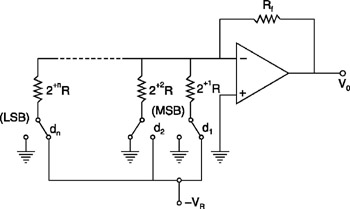
A weighted resistor DAC uses n switches for n different bits of binary word. It uses an operational amplifier in inverting amplifier mode and the resistors which are placed in different paths are multiplied by 2. This circuit is shown in Figure 7.2.


Figure 7.2: Weighted resistor DAC.
(7.2)

The major...

UNLIMITED FREE
ACCESS
TO THE WORLD'S BEST IDEAS

SUBMIT
Already a GlobalSpec user? Log in.

This is embarrasing...

An error occurred while processing the form. Please try again in a few minutes.

Customize Your GlobalSpec Experience

Category: Digital-to-Analog Converters
Finish!
Privacy Policy

This is embarrasing...

An error occurred while processing the form. Please try again in a few minutes.