The Linear and Digital Integrated Circuits Design Primer

The major limitation of an ordinary diode, which leads to the principle of using diodes with op-amps, is that an ordinary diode cannot rectify voltages below V r, the cut-in voltage of the diode. Therefore, ordinary diodes cannot be used to cut off the circuit for rectification of voltages below cut-off voltages, which typically range from 0.6 V to 0.7 V.
The important circuits using diodes are rectifiers, clippers, clampers, and peak value storage devices.
The circuit for a half-wave rectifier is shown in Figure 4.16.
When the input signal is positive, i.e., V i > 0, D 1 is forward biased and D 1 conducts. D 2 is reverse biased because V N = ? V r and D 2 does not conduct. Therefore, no current flows through R f and output voltage V o = 0.
When the input signal is negative, i.e., V i < 0, D 1 is reverse biased and D 1 does not conduct. Therefore, D 2 conducts and the circuit behaves like an inverter causing the output voltage to become positive.
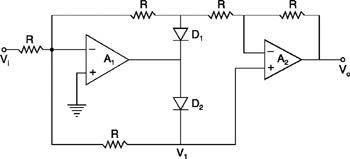
The circuit for a full-wave rectifier, or absolute value circuit or modulus value circuit is shown in Figure 4.18.
When the input voltage V i is positive, D 1