
ISO Flexible Circuits
Last Updated: April 1, 2025
Description
ISO Flexible Circuits are a type of printed wiring interconnect structure built on thin, flexible substrates. These circuits are designed to be bendable, allowing them to complete three-dimensional wiring configurations that cannot be achieved with rigid circuit boards. They primarily serve cabling functions, providing a reliable alternative to conventional wiring by improving connection reliability and simplifying assembly.
Working Principle
Flexible circuits operate by utilizing a patterned arrangement of printed wiring on a flexible base material, often with flexible cover layers. The typical construction involves a base layer, a metal foil or conductor layer, an adhesive layer, and outer insulating layers. The base and cover layers are usually made from flexible polymer films, such as polyimide, which provide excellent electrical, mechanical, chemical, and thermal properties. These circuits are useful because they can be bent, folded, or shaped to interconnect multiple planes or conform to specific package sizes, making them ideal for dynamic applications and environments with space constraints.
Applications
Flexible circuits are used in a wide range of industries and applications. Specific examples include their use in car radios, cassette players, electronic control systems, hard disk drives, printers, optoelectronics, switching systems, industrial controls, and medical devices such as heart pacemakers and hearing aids. They are also employed in advanced scientific sensors, flexible heating elements, and security devices. Notably, all-polyimide flexible circuits have been used in NASA vehicles exploring Mars, contributing to panoramic views and the search for water on the Martian surface.
Advantages over other Flexible Circuits
Flexible circuits offer several advantages over other wiring methods. They are more resistant to shock and vibration than rigid PCBs, which reduces repair and replacement costs. Their thin, lightweight, and durable nature makes them suitable for high-density circuitry and fine line traces. Additionally, they provide a cleaner and neater appearance by eliminating bulky wires and are designed to meet a wide range of temperature and environmental extremes.
Limitations
Despite their advantages, flexible circuits have limitations due to their unstable thin constructions. These circuits may require careful handling to avoid damage during installation and servicing. The need for specialized materials and manufacturing processes can also increase initial costs compared to traditional wiring methods.
Considerations
When considering flexible circuits, it is important to account for initial costs, which may be higher due to the specialized materials and manufacturing processes involved. However, their durability and resistance to environmental extremes can lead to lower operating expenses over time. Flexible circuits are generally reliable and provide high cycle life, but their accuracy and performance depend on the quality of materials and manufacturing standards. Replacement and maintenance costs are typically lower than those for rigid PCBs, as flexible circuits are designed to withstand dynamic applications and vibration conditions.

from Flexible Circuit Technologies, Inc.
A double sided flex circuit is a circuit having two conductive layers, one on each side of the base layer of polyimide within the circuit. Trace patterns, specific to your needs, can be created on both sides of the substrate film and can be connected where desired with copper plated through-holes. [See More]
- Certifications: ISO; RoHS (optional feature); Other; ISO 9001, 14001, ISO13485, IATF 16949, RoHS, and more
- Mounting: Press Fit (optional feature); Surface Mount (optional feature); Through-Hole (optional feature)
- Applications: Automotive Equipment; Commercial Equipment; Industrial Equipment; Medical Equipment; Telecommunication Equipment; Other; Consumer
- Substrates: Polymide

from Flexible Circuit Technologies, Inc.
A dual access flex circuit is a single sided flex circuit that is manufactured so that the conductive material can be accessed from both sides of the circuit. Flexible Circuit is a front runner in this technology utilizing specialized lasers and processing to skive open the polyimide layer of the... [See More]
- Certifications: ISO; RoHS (optional feature); Other; ISO 9001, 14001, ISO13485, IATF 16949, RoHS, and more
- Mounting: Press Fit (optional feature); Surface Mount (optional feature); Through-Hole (optional feature)
- Applications: Automotive Equipment; Commercial Equipment; Industrial Equipment; Medical Equipment; Telecommunication Equipment; Other; Consumer
- Substrates: Polymide

from Flexible Circuit Technologies, Inc.
Rigid flex circuits have been used in the military and aerospace industries for more than 20 years. In most rigid flex circuit boards, the circuitry consists of multiple flexible circuit inner layers selectively attached together using an epoxy pre-preg bonding film, similar to a multilayer flexible... [See More]
- Certifications: ISO; RoHS (optional feature); Other; ISO 9001, 14001, ISO13485, IATF 16949, RoHS, and more
- Mounting: Press Fit (optional feature); Surface Mount (optional feature); Through-Hole (optional feature)
- Applications: Automotive Equipment; Commercial Equipment; Industrial Equipment; Medical Equipment; Telecommunication Equipment; Other; Consumer
- Substrates: Polymide
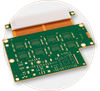
from Flexible Circuit Technologies, Inc.
A four-layer combination rigid flex circuit has four conductive copper layers. Typically, a four-layer has two flexible layers and two rigid layers. Rigid flex circuits have been used in the military and aerospace industries for more than 20 years. In most rigid flex circuit boards, the circuitry... [See More]
- Certifications: ISO; RoHS (optional feature); Other; ISO 9001, 14001, ISO13485, IATF 16949, RoHS, and more
- Mounting: Press Fit (optional feature); Surface Mount (optional feature); Through-Hole (optional feature)
- Applications: Automotive Equipment; Commercial Equipment; Industrial Equipment; Medical Equipment; Telecommunication Equipment; Other; Consumer
- Substrates: Polymide

from Flexible Circuit Technologies, Inc.
A multi layer flex circuit combine several single-sided or double-sided circuits with complex interconnections, shielding and/or surface mounted technologies in a multi layer design. The multi layers may or may not be continuously laminated together throughout the production process. If your design... [See More]
- Certifications: ISO; RoHS (optional feature); Other; ISO 9001, 14001, ISO13485, IATF 16949, RoHS, and more
- Mounting: Press Fit (optional feature); Surface Mount (optional feature); Through-Hole (optional feature)
- Applications: Automotive Equipment; Commercial Equipment; Industrial Equipment; Medical Equipment; Telecommunication Equipment; Other; Consumer
- Substrates: Polymide

from Flexible Circuit Technologies, Inc.
A single layer flex circuit is the most basic and consists of a flexible polyimide film laminated to a thin sheet of copper. The copper layer is then chemically etched to produce a circuit pattern specific to your specific design requirements. A polyimide coverlay is then added for insulation and... [See More]
- Certifications: ISO; RoHS (optional feature); Other; ISO 9001, 14001, ISO13485, IATF 16949, RoHS, and more
- Mounting: Press Fit (optional feature); Surface Mount (optional feature); Through-Hole (optional feature)
- Applications: Automotive Equipment; Commercial Equipment; Industrial Equipment; Medical Equipment; Telecommunication Equipment; Other; Consumer
- Substrates: Polymide

from Flexible Circuit Technologies, Inc.
A six-layer combination rigid flex circuit has six conductive copper layers. The two most common design types are as follows: Six-Layer Rigid Flex – Two flex layers and four rigid layers. Six-Layer Rigid Flex – Four flex layers and two rigid layers. Rigid flex circuits have been used in... [See More]
- Certifications: ISO; RoHS (optional feature); Other; ISO 9001, 14001, ISO13485, IATF 16949, RoHS, and more
- Mounting: Press Fit (optional feature); Surface Mount (optional feature); Through-Hole (optional feature)
- Applications: Automotive Equipment; Commercial Equipment; Industrial Equipment; Medical Equipment; Telecommunication Equipment; Other; Consumer
- Substrates: Polymide