
Telecommunication Equipment Flexible Circuits
Last Updated: April 1, 2025
Description
Telecommunication equipment flexible circuits are specialized printed wiring interconnect structures built on thin, flexible substrates. These circuits are designed to interconnect various components within telecommunication devices, providing a reliable and efficient means of electrical connectivity. They are capable of bending and folding, allowing them to fit into compact and complex spaces that rigid circuit boards cannot accommodate.
Working Principle
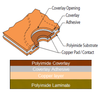
Flexible circuits operate by utilizing a flexible polymer film laminated to a thin sheet of copper, which is etched to create a circuit pattern. This construction allows the circuits to be bent and shaped to fit specific configurations, making them ideal for applications where space and weight are critical factors. The flexibility of these circuits enables them to connect moving components, which is essential in dynamic environments. Their design also includes plated through-holes and polymer overcoats for electrical insulation and protection against contaminants, enhancing their durability and reliability.
Applications
In telecommunications, flexible circuits are used in a variety of applications, including switching systems and electronic control systems. They are also employed in the manufacturing of car radios and cassette players, where space constraints and the need for reliable connections are paramount. Additionally, flexible circuits are integral to the design of hard disk drives and printers, where they facilitate the connection of moving parts.
Advantages over other Flexible Circuits
Flexible circuits offer several advantages over traditional wiring methods and rigid circuit boards. They improve connection reliability and simplify assembly, reducing errors during installation and servicing. Their resistance to shock and vibration makes them more durable and cost-effective in terms of repair and replacement. Furthermore, their lightweight and thin design make them suitable for high-density circuitry and applications requiring fine line traces.
Limitations
Despite their advantages, flexible circuits have limitations due to their thin and unstable construction. They may not be suitable for all applications, particularly those requiring high mechanical strength or rigidity. The manufacturing process can also be more complex and costly compared to traditional circuit boards.
Considerations
When considering the use of flexible circuits in telecommunication equipment, it is important to evaluate initial costs, which can be higher due to the specialized materials and manufacturing processes involved. Operating expenses may be reduced over time due to their durability and reduced need for maintenance. However, considerations regarding durability, accuracy, and replacement costs should be taken into account, as these factors can impact the overall cost-effectiveness of using flexible circuits in specific applications.
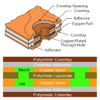
from PFC Flexible Circuits Limited
Double-sided circuits have two layers of copper laminated between polyimide dielectrics. In most cases, the two layers of copper are electrically connected by drilling small holes through the copper circuits and the separating dielectric. The holes are then plated with copper to make a connection... [See More]
- Applications: Aerospace Equipment; Commercial Equipment; Industrial Equipment; Medical Equipment; Telecommunication Equipment
- Number of Layers: 2
- Substrates: Polymide
- Features: Double Sided

from Flexible Circuit Technologies, Inc.
A double sided flex circuit is a circuit having two conductive layers, one on each side of the base layer of polyimide within the circuit. Trace patterns, specific to your needs, can be created on both sides of the substrate film and can be connected where desired with copper plated through-holes. [See More]
- Applications: Automotive Equipment; Commercial Equipment; Industrial Equipment; Medical Equipment; Telecommunication Equipment; Other; Consumer
- Substrates: Polymide
- Mounting: Press Fit (optional feature); Surface Mount (optional feature); Through-Hole (optional feature)
- Surface Finish: Carbon (optional feature); Gold (optional feature); Nickel (optional feature); Organic (optional feature); Silver (optional feature); Solder (optional feature); Tin (optional feature); Other (optional feature); entek or Organic Solderability Preservative (OSP), Lead Solder or RoHS Compliant
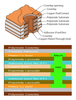
from PFC Flexible Circuits Limited
Multi-layer flexible circuits combine several single-sided or double-sided circuits with complex interconnections, shielding and/or surface mounted technologies in a multilayer design. The number of conductor layers designed into multi-layer flex circuits are limitless. The package size, layer count... [See More]
- Applications: Aerospace Equipment; Commercial Equipment; Industrial Equipment; Medical Equipment; Telecommunication Equipment
- Number of Layers: 4
- Mounting: Surface Mount; Through-Hole
- Features: Multi Layer; Shielding

from Flexible Circuit Technologies, Inc.
A dual access flex circuit is a single sided flex circuit that is manufactured so that the conductive material can be accessed from both sides of the circuit. Flexible Circuit is a front runner in this technology utilizing specialized lasers and processing to skive open the polyimide layer of the... [See More]
- Applications: Automotive Equipment; Commercial Equipment; Industrial Equipment; Medical Equipment; Telecommunication Equipment; Other; Consumer
- Substrates: Polymide
- Mounting: Press Fit (optional feature); Surface Mount (optional feature); Through-Hole (optional feature)
- Surface Finish: Carbon (optional feature); Gold (optional feature); Nickel (optional feature); Organic (optional feature); Silver (optional feature); Solder (optional feature); Tin (optional feature); Other (optional feature); entek or Organic Solderability Preservative (OSP), Lead Solder or RoHS Compliant

from PFC Flexible Circuits Limited
PFC has created the PFC High Speed Data Link Flexible Circuits product line, in collaboration with Samtec. The PFC Data Link is a direct cross to the Samtec Data Link product line, a leader in transmitting and receiving digital information. Our strategic partnership with Samtec has provided... [See More]
- Applications: Aerospace Equipment; Commercial Equipment; Industrial Equipment; Medical Equipment; Telecommunication Equipment
from Flexible Circuit Technologies, Inc.
Rigid flex circuits have been used in the military and aerospace industries for more than 20 years. In most rigid flex circuit boards, the circuitry consists of multiple flexible circuit inner layers selectively attached together using an epoxy pre-preg bonding film, similar to a multilayer flexible... [See More]
- Applications: Automotive Equipment; Commercial Equipment; Industrial Equipment; Medical Equipment; Telecommunication Equipment; Other; Consumer
- Substrates: Polymide
- Mounting: Press Fit (optional feature); Surface Mount (optional feature); Through-Hole (optional feature)
- Surface Finish: Carbon (optional feature); Gold (optional feature); Nickel (optional feature); Organic (optional feature); Silver (optional feature); Solder (optional feature); Tin (optional feature); Other (optional feature); entek or Organic Solderability Preservative (OSP), Lead Solder or RoHS Compliant
from PFC Flexible Circuits Limited
Rigid flex circuits combine the benefits of rigid boards and flexible circuits integrated into one circuit. The two-in-one circuit is interconnected through plated through holes. Rigid flex circuits provide higher component density and better quality control. The slideshow below shows an eight layer... [See More]
- Applications: Aerospace Equipment; Commercial Equipment; Industrial Equipment; Medical Equipment; Telecommunication Equipment
- Features: Rigid Flex
- Number of Layers: 4

from Flexible Circuit Technologies, Inc.
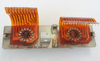
Flat flex circuits are light weight, low profile, small outline cables designed to satisfy high density cabling applications. Their distinguishing factors include repeated dynamic flexing and the ability to fold into nearly any shape, evenly distributing stress especially when compared to... [See More]
- Applications: Automotive Equipment; Commercial Equipment; Industrial Equipment; Medical Equipment; Telecommunication Equipment; Other; Consumer
- Substrates: Polymide
- Mounting: Press Fit (optional feature); Surface Mount (optional feature); Through-Hole (optional feature)
- Surface Finish: Tin
from PFC Flexible Circuits Limited
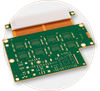
Sculpted flexible circuits have sculpted pins, which are made as a through-hole connector. Sculptured terminal pins are built-in and extended beyond the boundary of the polyimide base material. These pins are plugged into a series of holes in a PCB and then soldered. This circuit design, is also... [See More]
- Applications: Aerospace Equipment; Commercial Equipment; Industrial Equipment; Medical Equipment; Telecommunication Equipment
- Substrates: Polymide
- Mounting: Surface Mount
from Flexible Circuit Technologies, Inc.
A four-layer combination rigid flex circuit has four conductive copper layers. Typically, a four-layer has two flexible layers and two rigid layers. Rigid flex circuits have been used in the military and aerospace industries for more than 20 years. In most rigid flex circuit boards, the circuitry... [See More]
- Applications: Automotive Equipment; Commercial Equipment; Industrial Equipment; Medical Equipment; Telecommunication Equipment; Other; Consumer
- Substrates: Polymide
- Mounting: Press Fit (optional feature); Surface Mount (optional feature); Through-Hole (optional feature)
- Surface Finish: Carbon (optional feature); Gold (optional feature); Nickel (optional feature); Organic (optional feature); Silver (optional feature); Solder (optional feature); Tin (optional feature); Other (optional feature); entek or Organic Solderability Preservative (OSP), Lead Solder or RoHS Compliant
from PFC Flexible Circuits Limited
Single-sided flex circuits are the most basic type of flexible circuits. They have one layer of copper laminated between polyimide dielectrics. We chemically etch the copper layer to produce a circuit pattern specific to design requirements. Stiffeners, pins, connectors, and components, are... [See More]
- Applications: Aerospace Equipment; Commercial Equipment; Industrial Equipment; Medical Equipment; Telecommunication Equipment
- Substrates: Polymide
- Mounting: Surface Mount; Through-Hole
- Number of Layers: 1

from Flexible Circuit Technologies, Inc.
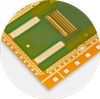
A multi layer flex circuit combine several single-sided or double-sided circuits with complex interconnections, shielding and/or surface mounted technologies in a multi layer design. The multi layers may or may not be continuously laminated together throughout the production process. If your design... [See More]
- Applications: Automotive Equipment; Commercial Equipment; Industrial Equipment; Medical Equipment; Telecommunication Equipment; Other; Consumer
- Substrates: Polymide
- Mounting: Press Fit (optional feature); Surface Mount (optional feature); Through-Hole (optional feature)
- Surface Finish: Carbon (optional feature); Gold (optional feature); Nickel (optional feature); Organic (optional feature); Silver (optional feature); Solder (optional feature); Tin (optional feature); Other (optional feature); entek or Organic Solderability Preservative (OSP), Lead Solder or RoHS Compliant
from Flexible Circuit Technologies, Inc.
A single layer flex circuit is the most basic and consists of a flexible polyimide film laminated to a thin sheet of copper. The copper layer is then chemically etched to produce a circuit pattern specific to your specific design requirements. A polyimide coverlay is then added for insulation and... [See More]
- Applications: Automotive Equipment; Commercial Equipment; Industrial Equipment; Medical Equipment; Telecommunication Equipment; Other; Consumer
- Substrates: Polymide
- Mounting: Press Fit (optional feature); Surface Mount (optional feature); Through-Hole (optional feature)
- Surface Finish: Carbon (optional feature); Gold (optional feature); Nickel (optional feature); Organic (optional feature); Silver (optional feature); Solder (optional feature); Tin (optional feature); Other (optional feature); entek or Organic Solderability Preservative (OSP), Lead Solder or RoHS Compliant

from Johnson Electric North America, Inc.
Contact plates are designed and tested to connection reliability with best in class anti-corrosion. The contact plates are used in Telecom (SIM card), Banking, Government and Healthcare identification (smart card). Dual interface contact plates are designed to integrate both contact and contactless... [See More]
- Applications: Aerospace Equipment; Automotive Equipment; Industrial Equipment; Medical Equipment; Telecommunication Equipment; Other; Banking, Government
- Surface Finish: Gold (optional feature); Nickel (optional feature); Other (optional feature); Copper, Palladium
- Substrates: Other; PET
- Number of Layers: 1 to 2