
Through-Hole Flexible Circuits
Last Updated: April 1, 2025
Description
Through-Hole Flexible Circuits are a type of flexible circuit that incorporate plated through-holes to connect conductors across multiple layers. These circuits are designed to interconnect various components in a three-dimensional package, providing a reliable alternative to conventional wiring methods. They are constructed on thin, flexible substrates, allowing them to be bent, folded, or shaped to fit specific package sizes and configurations.
Working Principle
Through-Hole Flexible Circuits work by utilizing a flexible, polymer film laminated to a thin sheet of copper, which is etched to create circuit patterns. These patterns can be on one or both sides of the film, and plated through-holes are used to connect conductors across different layers. This design allows the circuits to maintain electrical connectivity while being flexible enough to accommodate movement and vibration. The flexibility and durability of these circuits make them useful in applications where space and weight constraints are critical, and where traditional rigid circuit boards would not suffice.
Applications
Through-Hole Flexible Circuits are used in a variety of applications, particularly where high-density wiring is required in a compact space. Specific examples include:
- Medical devices such as heart pacemakers and hearing aids, where reliability and compactness are crucial.
- Automotive electronics, including car radios and electronic control systems, where flexibility and durability are needed.
- Aerospace and military applications, where circuits must withstand demanding environments and provide reliable performance.
Advantages over other Flexible Circuits
Through-Hole Flexible Circuits offer several advantages over other types of flexible circuits. They provide improved connection reliability and simplify assembly processes, reducing errors during installation and servicing. Their resistance to shock and vibration makes them more durable and less costly to repair or replace compared to rigid PCBs. Additionally, their ability to connect moving components makes them ideal for dynamic applications, such as in disk drives and printer heads.
Limitations
Despite their advantages, Through-Hole Flexible Circuits have limitations. The manufacturing process can be complex and costly, particularly for multilayer designs. The thin construction of these circuits can also lead to stability issues if not properly designed and manufactured. Additionally, the initial cost of these circuits can be higher compared to traditional wiring methods, which may be a consideration for some applications.
Considerations
When considering Through-Hole Flexible Circuits, several factors should be taken into account:
- Initial Costs: The design and manufacturing of these circuits can be expensive, especially for complex, multilayer configurations.
- Operating Expense: While they offer long-term reliability, the initial investment may be higher than other wiring methods.
- Durability: These circuits are highly durable and resistant to environmental extremes, making them suitable for demanding applications.
- Accuracy: The precision in design and manufacturing ensures high accuracy in electrical connectivity.
- Replacement and Maintenance Costs: Due to their durability and reliability, replacement and maintenance costs are generally lower compared to rigid PCBs. However, any necessary repairs may require specialized skills and equipment.
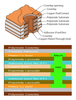
from PFC Flexible Circuits Limited
Multi-layer flexible circuits combine several single-sided or double-sided circuits with complex interconnections, shielding and/or surface mounted technologies in a multilayer design. The number of conductor layers designed into multi-layer flex circuits are limitless. The package size, layer count... [See More]
- Mounting: Surface Mount; Through-Hole
- Number of Layers: 4
- Applications: Aerospace Equipment; Commercial Equipment; Industrial Equipment; Medical Equipment; Telecommunication Equipment
- Features: Multi Layer; Shielding

from PFC Flexible Circuits Limited
PFC Flex Circuit Assembly, 3 layers, IPC 6013 class 2, RoHS compliant. Differential pairs, 100 Ohms, +/-10% impedance control. Samtec QSE and QTE High Speed Ground Plane Socket interface – 14, 28, and 42 positions. Standard lengths are 3, 5 and 10 inches (custom lengths available –... [See More]
- Mounting: Through-Hole
- Number of Layers: 3
- Applications: Aerospace Equipment; Commercial Equipment; Industrial Equipment; Medical Equipment; Telecommunication Equipment
- Features: Multi Layer

from Sheldahl Flexible Technologies - a Flex company
Novaclad ® HDI is built upon the rock of our proprietary adhesiveless laminate that leverages vacuum deposition, additive copper processes, and photolithography to enable fine line circuitry coupled with laser-drilled micro-vias. Novaclad HDI circuitry withstands the toughest conditions in terms... [See More]
- Mounting: Surface Mount; Through-Hole
- Substrates: Other; PI Film
- Applications: Aerospace Equipment; Automotive Equipment; Commercial Equipment; Industrial Equipment; Medical Equipment; Military Equipment
- Surface Finish: Gold; Nickel; Silver; Tin