
Analog Switching Solid State Relays
Description
Analog Switching Solid State Relays are electronic devices that use semiconductor technology to switch signals between input and output. They are designed to provide fast and reliable switching without mechanical wear, ensuring excellent insertion loss repeatability.
Working Principle
Analog Switching Solid State Relays operate by using semiconductor components to control the flow of electrical signals. These relays are much faster than traditional electromechanical relays, capable of reaching sampling rates of several MHz. They are useful because they offer high reliability and fast switching speeds, typically in the range of a few microseconds. Unlike mechanical relays, they do not suffer from mechanical wear, which enhances their longevity and performance consistency.
Applications
Analog Switching Solid State Relays are used in various applications where fast and reliable signal switching is required. Specific examples include multiplexing systems where they serve as an array of switches to connect multiple input channels. They are also used in RF applications, where their ability to handle frequencies from 0.5 MHz to 18 GHz makes them suitable for high-frequency signal routing.
Advantages over other Solid State Relays
Compared to other solid-state relays, analog switching solid-state relays offer significantly faster switching speeds, reaching several MHz, which is advantageous in applications requiring rapid signal processing. They also provide excellent insertion loss repeatability due to the absence of mechanical parts, which can degrade over time.
Limitations
One of the primary limitations of analog switching solid-state relays is their inability to handle high input voltages, typically limited to 25V. They are also not well-suited for isolated applications and are generally limited to handling currents of only one mA or less. Additionally, the ON resistance of these devices can range from 10 to 100 O, which may affect system measurement accuracy if not properly compensated.
Considerations
When considering the use of analog switching solid-state relays, it is important to evaluate the initial costs and operating expenses. While they offer high reliability and low maintenance due to the lack of mechanical parts, their limitations in handling high voltages and currents may necessitate additional components or systems to accommodate these needs. Durability is generally high, but accuracy can be affected by the ON resistance, which should be considered in precision applications. Replacement and maintenance costs are typically lower than mechanical relays due to the absence of moving parts.
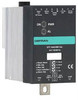
from Gefran
The GTT family of solid-state relays has been designed with the aim of providing very accurate control of the load from an analogue input signal (0-10V or 0-20/4-20mA) or a potentiometer (from 1kOhm to 10kOhm ). The electronic design ensures that the cycle time for proportioning the power is... [See More]
- Features: Analog Switching; Built-in Heat Sink; Visual Indicator
- Mounting: DIN; Panel (optional feature)
- Application Type: General
- Input Voltage (Control Signal) Type: AC

from Gefran
The GT family of solid-state relays has been designed with the aim of providing very accurate control of the load thanks to an analog control input, in voltage at 0 …5V; 0 …10V or in current at 0 …20/4 …20mA or a potentiometer (from 1Kohm to 10 Kohm). The electronic... [See More]
- Features: Analog Switching; Visual Indicator
- Mounting: DIN; Panel (optional feature)
- Application Type: General
- Input Voltage (Control Signal) Type: AC