
Stop Cushioning Electric Rotary Actuators
Description
Stop cushioning electric rotary actuators are devices designed to drive components rotationally using electromagnetic power from a motor. They are equipped with special features such as cushioning to soften stops, which helps in reducing the impact and noise during operation. These actuators typically provide control and indexing capabilities, allowing for multiple position stops along their rotational strokes.
Working Principle
Electric rotary actuators operate by converting electrical energy into rotational motion through a motor. The motor drives a shaft or table, which can be adjusted to achieve the desired angle of rotation. The cushioning feature in these actuators is designed to absorb shock and reduce the impact at the end of the stroke, thereby protecting the components and extending the life of the actuator. This makes them particularly useful in applications where precise control and smooth operation are critical.
Applications
Electric rotary actuators with stop cushioning are used in a variety of applications. They are suitable for semiconductor manufacturing operations, where precise positioning is essential. In the automotive industry, they are used in car seats for adjusting positions smoothly. They are also employed in the electric power industry for high-power switching gears and in packaging applications where controlled rotational motion is required.
Advantages over other Electric Rotary Actuators
One of the key advantages of stop cushioning electric rotary actuators is their ability to reduce noise and impact during operation, which is not always present in other types of actuators. This feature enhances the durability and longevity of the actuator and the components it interacts with. Additionally, the precise control and indexing capabilities allow for more accurate positioning compared to some other actuator types.
Limitations
Despite their advantages, stop cushioning electric rotary actuators have limitations. They may not be suitable for environments that are hazardous or flammable unless specifically rated for such conditions. Overheating can also be a concern if the actuator is operated beyond its specified duty cycle, potentially reducing its efficiency and lifespan.
Considerations
When selecting stop cushioning electric rotary actuators, several factors should be considered. Initial costs can vary depending on the specific features and capabilities required. Operating expenses are generally moderate, but it's important to ensure that the actuator is used within its specified limits to avoid overheating and potential damage. Durability is enhanced by the cushioning feature, but regular maintenance is necessary to ensure optimal performance. Accuracy is a significant advantage, making these actuators suitable for applications requiring precise control. Replacement and maintenance costs should be factored into the overall cost of ownership, as these can impact long-term expenses.
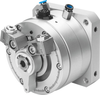
from Festo Corporation
With rotary vane. Integrated rotary potentiometer. Suitable for servopneumatic applications with stepping motor driver CPX-CMAX, end-position controller CPX-CMPX, or SPC11 and measuring module CPX-CMIX. Compact design [See More]
- Supply Voltage: 10
- Radial Load: 26.98
- Axial Load: 11.24
- Operating Temperature: 14 to 140
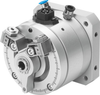
from Festo Corporation
With rotary vane. Integrated rotary potentiometer. Suitable for servopneumatic applications with stepping motor driver CPX-CMAX, end-position controller CPX-CMPX, or SPC11 and measuring module CPX-CMIX. Compact design [See More]
- Supply Voltage: 10
- Radial Load: 78.68
- Axial Load: 26.98
- Operating Temperature: 14 to 140

from Festo Corporation
With rotary vane. Integrated rotary potentiometer. Suitable for servopneumatic applications with stepping motor driver CPX-CMAX, end-position controller CPX-CMPX, or SPC11 and measuring module CPX-CMIX. Compact design [See More]
- Supply Voltage: 10
- Radial Load: 112
- Axial Load: 112
- Operating Temperature: 14 to 140